Garbatella: a different chapter in Rome’s neighborhood story
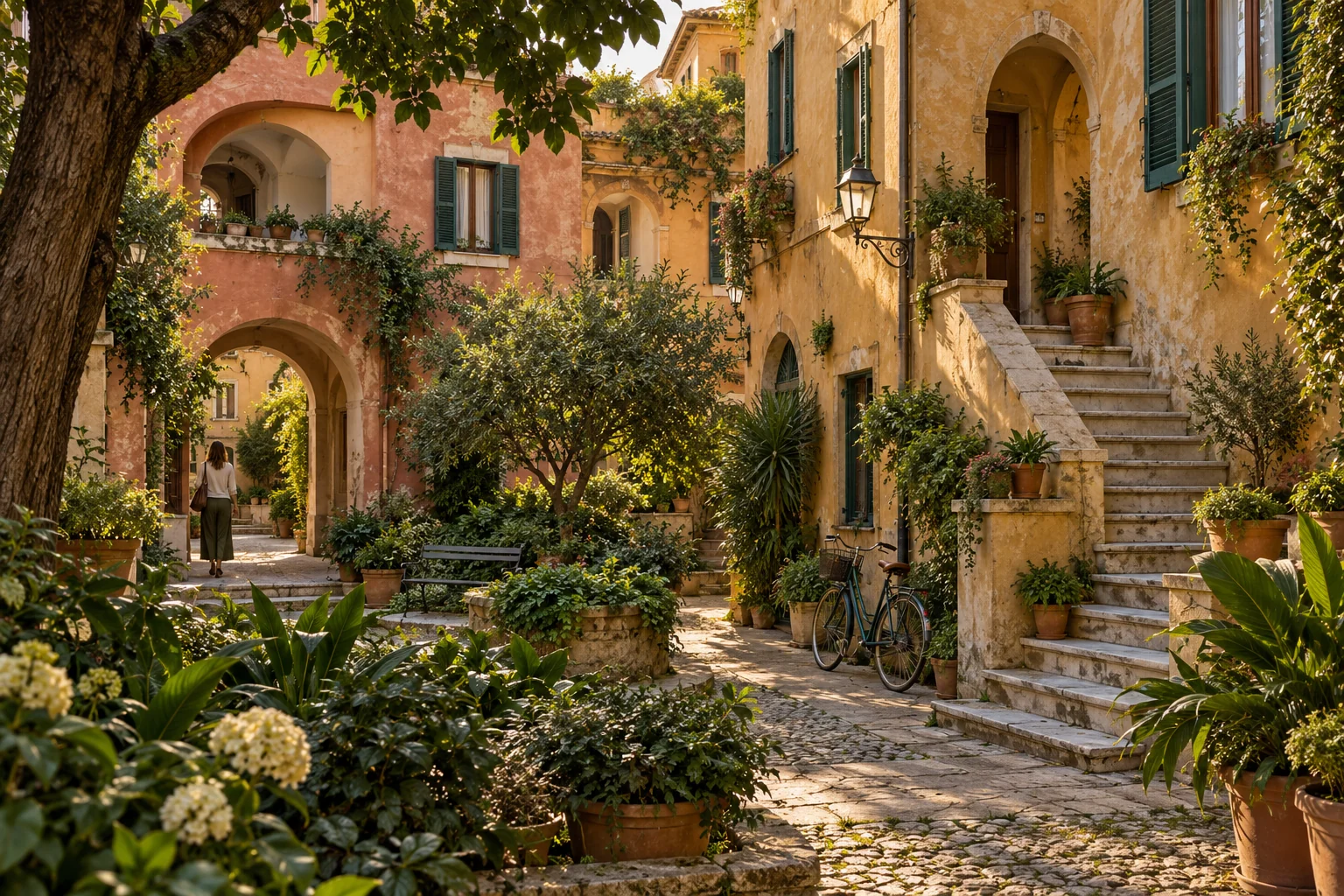
Garbatella offers a Roman history in which housing, shared space and twentieth-century planning take the lead. You will not find the same monumental sequence as around the Forum, and that is the point. A visit here asks how a neighborhood was designed for everyday life: where homes meet streets, where people gather, and how small variations give a larger development its character.
Make the outing a considered residential walk rather than a hunt for a secret Rome untouched by visitors. Garbatella is well known and lived in. A good route respects the difference between public space and the entrance to someone’s home. Start with Piazza Benedetto Brin and a manageable group of surrounding streets, using our neighborhood collection if you want a guide to explain the planning history.
Begin with a date and an idea
Rome’s municipal anniversary account identifies 18 February 1920 as the laying of Garbatella’s foundation stone at Piazza Brin. The official garden-city overview connects its early development with housing for the nearby Ostiense industrial area and explains the importance of residential lots, gardens and courtyards. These are useful starting facts, rather than a complete explanation of everything subsequently built here.
The garden-city idea gives you a question to carry through the walk: how might green space and the arrangement of homes affect daily life? Look for the relationship between entrances, paths and small open areas. Do not assume that every visible garden was designed for the same purpose or remains accessible in the same way. Neighborhoods continue to change after the original plan is drawn.
Read a street before collecting architectural labels
Choose a public viewpoint and look at one short stretch of buildings. Are the doors directly on the street or reached through another space? Does the route feel straight and formal or curved and exploratory? How do stairs, balconies and rooflines alter the rhythm? You can describe these differences accurately without confidently assigning every feature to an architectural style.
A knowledgeable guide can then add terminology and evidence. The municipal neighborhood page provides context for preparation, but the walk should still involve looking rather than reciting a summary. Try comparing two nearby fronts: one elaborate and one restrained, or one closely connected to street activity and another set back. Differences often make the planning ideas easier to understand than a single photogenic façade.
Courtyards are not automatically visitor attractions
An open gate does not make a residential courtyard public. Stay on public routes unless you have clear permission to enter, and avoid blocking doorways while listening to a guide. Do not photograph through windows or closely frame residents as local color. These are ordinary courtesies, but they become especially important when a neighborhood’s appeal is closely tied to its domestic scale.
The same care applies to sound. A small group speaking softly can still become intrusive if it stops beneath someone’s open window. Choose wider public stopping points and keep explanations moving when necessary. A respectful walk does not need access to every picturesque corner. Often the most interesting relationship between housing and street can be understood perfectly well from outside.
Put the neighborhood beside industrial Rome
Garbatella becomes more legible when connected intellectually with the work and infrastructure around it. Centrale Montemartini offers a museum encounter with Rome’s industrial past, while Testaccio raises questions about food supply, trade and labor. You do not need to visit all three on the same day; even reading the linked guides can provide a useful framework for the neighborhood walk.
If combining places, plot the actual transitions before booking. A shared theme is not proof of a compact route, and a museum’s final admission time may dictate the order. Allow space for a meal and for getting to the next entrance. The best combination is one in which the connection becomes clearer without the logistics consuming the afternoon.
Leave room for present-day life
A neighborhood is not an exhibit frozen at its founding. Pay attention to current shops, services and public use without making sweeping claims about who lives here or how “real Romans” behave. One observed café scene cannot stand for an entire community. Enjoy what you see, and keep broad social conclusions proportional to the evidence you actually have.
Use the transport guide to plan a straightforward return, or fit Garbatella into the flexible final day of our four-day Rome outline. The reward is a wider idea of the city: Rome as a place where people have repeatedly tried to design good homes and shared surroundings, not only as a storehouse of temples, churches and famous views.
Sources & further reading
Turn a good read into a great day.
Find a highly rated Rome experience that brings these stories to life.
Explore related experiences →