What can you see around Piazza del Popolo in a short visit?
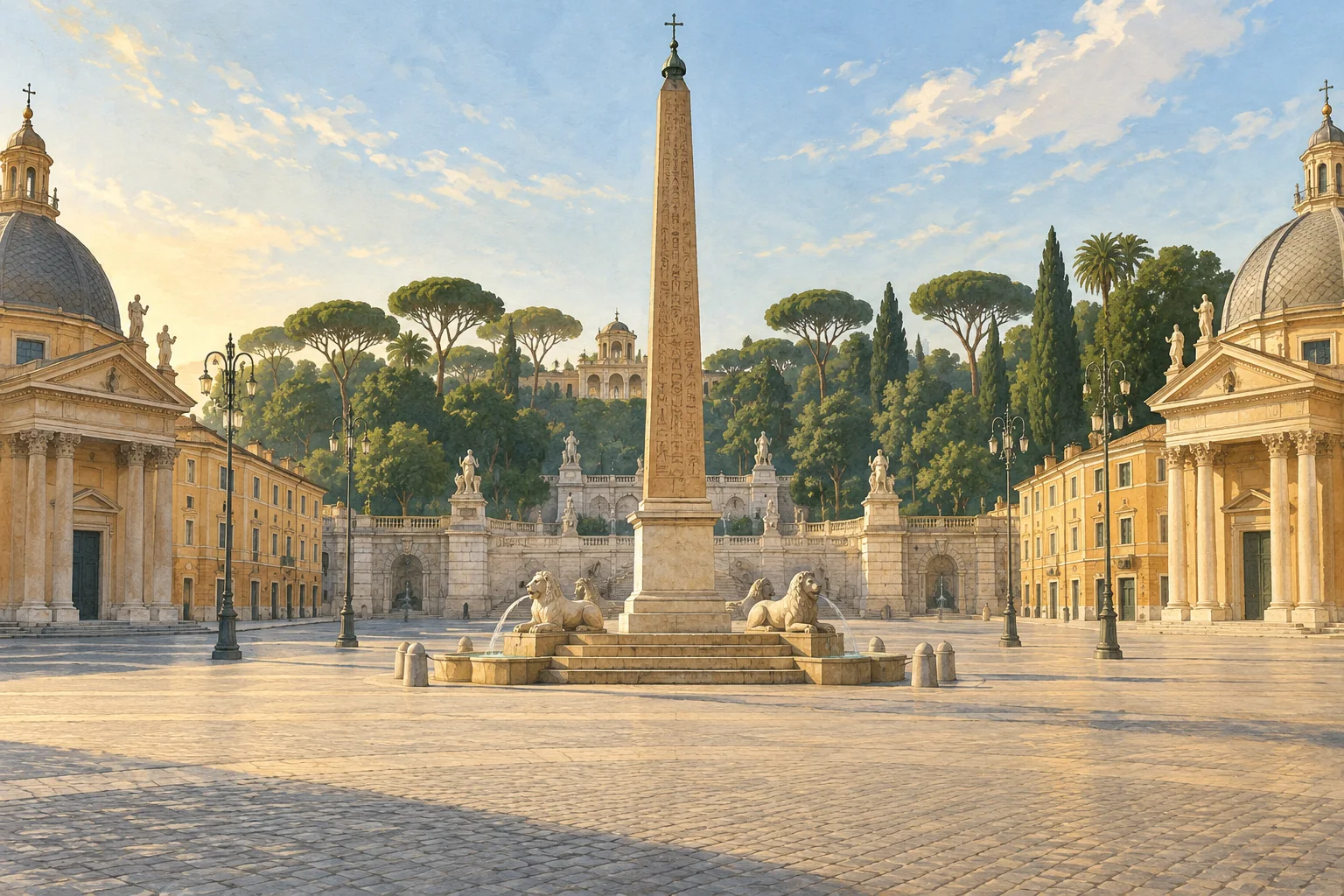
Piazza del Popolo rewards a short visit because its main subject is the space itself. You can understand quite a lot without joining a queue: the tall obelisk makes a centre, the curved sides hold the square together, and three streets pull your attention toward the city beyond. If you have limited time, begin with that large pattern. An optional climb toward the Pincio can come afterwards, once you know whether your feet and schedule agree.
The useful question is not how many attractions fit into an hour. It is which small sequence will leave you with a clear memory. Try centre, edge, then viewpoint. This approach works particularly well on an arrival day, when you may want fresh air and orientation rather than another complicated reservation. Our Rome neighborhood guide can help you place the square within the rest of your stay.
Start with the obelisk and the shape of the square
According to Turismo Roma’s account, the Flaminio obelisk was brought to Rome under Augustus and moved here from the Circus Maximus in 1589. That history makes it a useful reminder that a monument’s present address is not always its first Roman address. Look at the relationship between the narrow vertical shaft and the wide space around it before trying to inspect decorative details.
Then turn slowly and notice how the square offers several competing directions. You do not need a perfect photograph from its exact centre. Step out of moving pedestrian lines, especially around the fountains, and let the geometry settle. A brief pause with the phone put away often tells you more than several tightly cropped images. If restoration barriers or an event alter the view, use the open public space that is available rather than trying to reach a particular camera position.
Compare the two sides instead of rushing down a street
Move toward one curved edge and look back. The city’s visitor information identifies fountain groups representing Rome and Neptune on opposing sides. Their figures give the architecture a subject, but you can enjoy the comparison without memorising every identification. Look for differences in silhouettes, gestures and the way water and stone occupy the lower part of the composition.
This is a good short-visit exercise for a group with different interests. One person can follow the history, another can compare the sculpture, and someone else can simply enjoy the scale. Agree on where you will reunite before separating. The open square can make people appear easy to find right up to the moment a large group crosses between you.
Read the three streets as a choice
Via del Babuino, Via del Corso and Via di Ripetta meet the square’s southern side. Think of them as possible continuations, not three assignments. Choosing one gives the walk a direction; trying to sample all three can leave a short visit feeling surprisingly scattered. Check the location of your next fixed commitment, then pick the street or return route that serves it.
If the river is your next interest, our Ara Pacis and river day offers a coherent continuation to plan separately. If you are still learning how Rome’s squares work, compare this setting with Piazza Navona’s different urban story. The comparison becomes more interesting when you notice shape and use, rather than calling every large space a piazza and moving on.
Add the Pincio only if it improves the visit
The Pincio terrace and promenade provide an elevated perspective over this part of Rome. The ascent changes the experience from observing a square to looking across the city. It is a worthwhile extension when you have the energy and time; it is not a compulsory finishing line. Check the current route and surface conditions, particularly if steps, slopes or a pushchair affect your plans.
A viewpoint also changes with the weather. In harsh light, the square below may be easier to read than distant details. On an overcast day, concentrate on roofs and layers rather than expecting a glowing skyline. Leave room for returning to street level and reaching your next stop. A beautiful view is less enjoyable when every minute spent looking feels borrowed from a ticketed entry elsewhere.
Keep one optional interior, not a string of promises
Churches and museums in the surrounding area may enrich a longer visit, but do not assume an interior will be open whenever you arrive. Check the venue’s own visitor information before making it the reason for your trip. For this short route, the outdoor sequence is enough. Compare Rome experiences suited to shorter visits if you prefer a guided introduction, checking duration and the actual meeting point carefully.
On a wider Italy trip, Florence Tour Hub’s Piazza della Signoria article offers an enjoyable comparison between sculpture and civic space. Piazza del Popolo gives you a different lesson: sometimes the most useful first encounter with a city is learning how to stand still in it.
Sources & further reading
Turn a good read into a great day.
Find a highly rated Rome experience that brings these stories to life.
Explore related experiences →