Piazza Navona: how an ancient stadium became a Roman square
Piazza Navona is a good place to discover that urban history can survive as a shape. The long open space feels different from a compact square because it follows the footprint of an ancient stadium. Later buildings, fountains and religious architecture transformed its appearance, but the underlying form still organizes how people move through it. You can begin understanding that relationship without entering a museum or reading an inscription.
Approach from one end if possible and look along the whole space before concentrating on a fountain. The first view is about proportion: length, width, edges and the curve at the end. Our walking experiences can add historical context, but a few deliberate observations will make any guided explanation easier to follow when it arrives.
Read the outline before the decoration
The municipal history of Piazza Navona identifies the ancient structure as the Stadium of Domitian, built for athletic contests. That distinction matters: the long shape should not lead you automatically to imagine chariot races. A familiar-looking plan does not establish a building’s function. Let the documented identification guide the picture in your mind, rather than borrowing a scene from a film set somewhere else.
Walk a short distance along an edge and compare that view with the one from the centre. Notice how the perimeter encloses activity while openings connect it to surrounding streets. A square works both as a destination and a passage. Visitors taking photographs, people crossing for practical reasons and businesses serving customers all use the same space with very different intentions.
Treat the fountains as carefully placed objects
The Fountain of the Four Rivers and the church of Sant’Agnese in Agone give the square a strong Baroque presence. Instead of memorizing every figure immediately, consider why such elaborate sculpture occupies the middle of a public place. How far away can you recognize a gesture? What happens when you move around it? Monumental sculpture needs to work for people arriving from more than one direction.
Do not climb, sit on protected edges or lean into a fountain for a better picture. Stand back and allow the surrounding architecture into the view. The relationship between object and setting often explains more than a tightly cropped image. If you are with children, ask them to identify an animal or a repeated form before supplying the adult explanation of what it represents.
Be cautious with stories that sound too perfect
Famous squares attract neat anecdotes about artists insulting rivals or secretly encoding a feud in a gesture. Such stories can be entertaining, but an engaging explanation should distinguish documented chronology from later legend. Ask a guide what evidence supports a story. A good historical visit can include uncertainty without losing its charm, especially in a city whose buildings have accumulated centuries of commentary.
The same principle applies to recreating the ancient stadium in your imagination. Archaeological remains and reconstructions serve different purposes. If you want to visit an underground or archaeological space, check its current entrance, opening arrangements and ticket separately. Seeing Piazza Navona does not automatically include entry to every site advertised nearby, even when they concern the same ancient structure.
Give yourself a modest looking exercise
Choose three things to remember: one aspect of the square’s outline, one sculptural detail and one way people use the space today. This small assignment prevents the stop from dissolving into an unfocused collection of photographs. It also lets different travelers contribute something: one notices architecture, another notices an expressive face, and another observes how everyone chooses the same patch of shade.
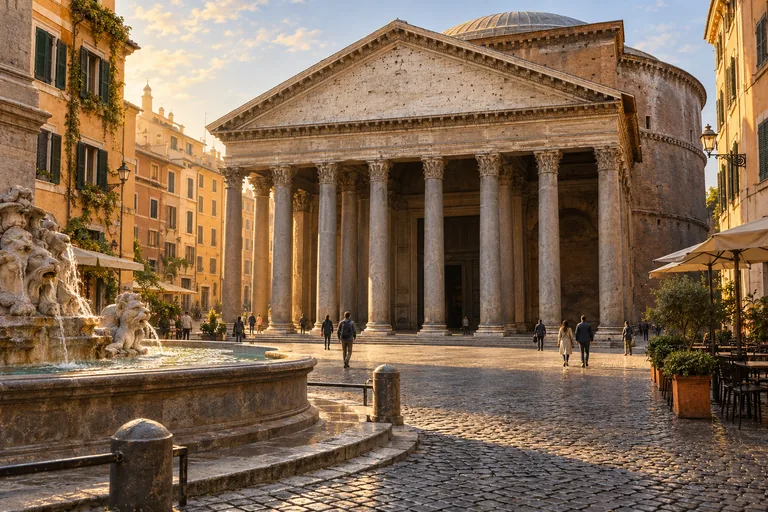
You can try the same exercise at the Pantheon, where a coherent interior replaces the open-air enclosure. The comparison is particularly useful for children and first-time visitors because it asks about experience rather than specialist vocabulary. You do not need to pronounce the names of every architectural feature to explain why two spaces feel different when you stand inside them.
Build a nearby afternoon around one extra idea
Continue toward a church-art visit if that interests you. Our guide to art in Roman churches includes the visual tricks of Sant’Ignazio; the official church description explains Andrea Pozzo’s painted illusion. Seeing real urban space followed by a painted expansion of space can make a coherent small afternoon, provided the church is open for sightseeing when you arrive.
Alternatively, follow the four-day Rome plan and let this be the end of the day’s formal sightseeing. Find a meal after checking the menu and prices, then enjoy the square without needing another fact. Piazza Navona’s value is not exhausted by its history. It is also a place where an ancient outline, later artistic ambitions and contemporary public life continue to share the same patch of Rome.
Sources & further reading
Turn a good read into a great day.
Find a highly rated Rome experience that brings these stories to life.
Explore related experiences →