Why does the Pantheon’s dome still make you look up?
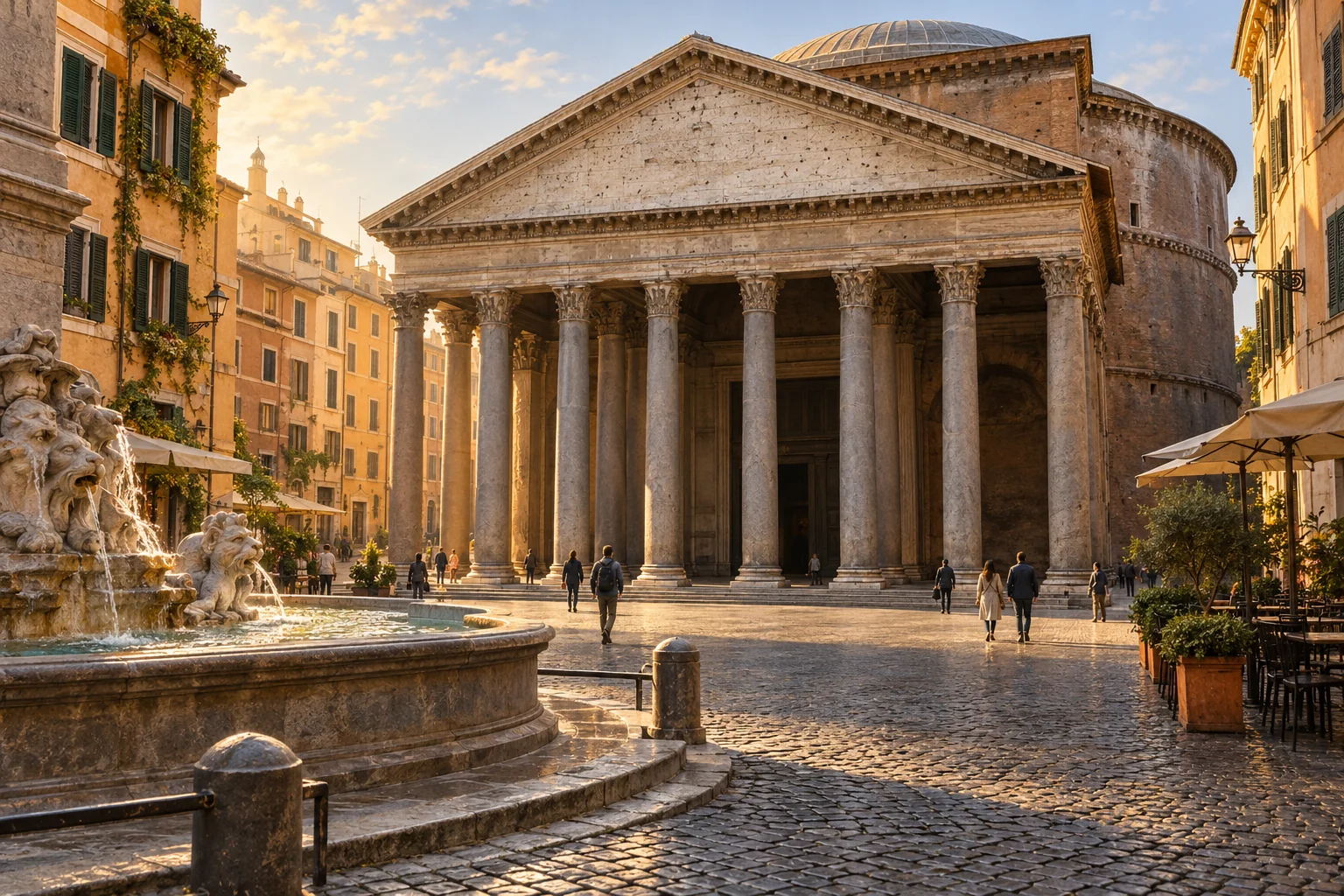
The Pantheon makes people look up because it turns an enormous enclosed space into something surprisingly legible. Your eye follows repeated shapes toward a single opening, while daylight changes the room without moving a wall. You can enjoy that effect before learning a measurement or an emperor’s name. Historical context then deepens what you have already noticed, rather than replacing the encounter with a list of impressive facts.
Begin outside in Piazza della Rotonda. The approach through surrounding streets gives the building a different character from a monument isolated in an archaeological park. Its façade belongs to an active square, and the interior remains a church as well as a historic site. Our history collection provides options for guided interpretation if you would like help connecting those different roles.
Start with the shape of the room
The official museum account places the present rebuilding in Hadrian’s period and describes a dome whose diameter corresponds to the interior height. The numerical relationship helps explain the sense of a coherent whole: the room can be understood as a powerful geometric idea, even though its construction required far more than drawing a simple shape on paper.
Try looking first at the overall volume, then at the patterned coffers, then at the opening above. Each offers a different scale of attention. Do not stop directly in the movement of people while staring upward; find a permitted place to pause. A visit becomes much more pleasant when your own moment of wonder does not accidentally block everyone else’s route into the room.
Light is part of the architecture
The oculus admits daylight through an actual opening. The municipal description also explains that rain can enter and drain through openings in the floor. This is a useful correction to the persistent idea that a clever ancient effect somehow prevents all water from entering. The remarkable building does not need an invented miracle to make it interesting.
Watch what light emphasizes on your particular visit. It may sharpen an edge, flatten a surface or gather attention in one portion of the room. Weather and time alter that experience, so photographs taken by someone else are not a guaranteed preview. Rather than arriving with one compulsory image in mind, give yourself permission to discover the light that is actually there.
Look beyond the single celebrated view
After looking upward, examine the relationship between the floor, lower walls and the dome. The temptation is to take the familiar oculus photograph and assume the important part is finished. A slower visit asks how the surrounding surfaces help the great opening feel so commanding. Color, scale and repetition create a setting in which that simple circle becomes difficult to ignore.
Keep observation and explanation separate. You might notice that a material looks different near the entrance, but understanding when it was installed requires evidence. Use labels, official interpretation or a qualified guide for historical claims. The Capitoline Museums guide offers a similar approach to looking: begin with what is visible, then use documented context to refine the questions it raises.
Remember the building’s continuing religious use
The Pantheon is also Santa Maria ad Martyres. A sightseeing visit should respect services, restricted areas and instructions from staff. Dress and behavior suitable for a church help keep the experience considerate. Do not assume that the quietest-looking corner is available for sitting or that every photograph is appropriate simply because the room is architecturally famous.
This continuing use is part of the building’s story, rather than an inconvenience attached to an ancient monument. It can prompt a broader question about Rome: how do structures survive by changing purpose? Avoid treating every alteration as damage to an imagined original. The city’s history includes the decisions of later communities as well as those of the people who first built a place.
Plan admission without confusing ticket types
Consult the official museum website for current admission arrangements and the authorized ticket channel. Read carefully when comparing guided experiences: an audio guide, a walking tour around the area and admission to the interior are different inclusions. A product photograph of the dome does not establish which of those you are buying. Leave time for any required checks and for finding the actual meeting point.
Afterwards, Piazza Navona makes a useful companion because its public shape also preserves an ancient idea in a later city. Or choose our church-art walk on a modest budget for a different approach to sacred interiors. The specialist Colosseum guide can develop another day’s ancient architecture; the Pantheon deserves its own pace, shaped by space and the changing light above.
Sources & further reading
Turn a good read into a great day.
Find a highly rated Rome experience that brings these stories to life.
Explore related experiences →