Why do the turtles on Rome’s Turtle Fountain seem to climb?

In Piazza Mattei, four bronze youths seem to be helping four turtles into a fountain. Look at the gap between one raised hand and the animal above it. The gesture is remarkably persuasive for a meeting that took the better part of a century to arrange. The young men belonged to the sixteenth-century fountain. The turtles arrived in the seventeenth. You can read most of that story standing in a single small square in Rome’s Sant’Angelo district.
Follow one figure from foot to hand
Begin a few paces back, far enough to see a whole side of the fountain. Each youth balances a foot against a dolphin. Below the dolphin is a shell-shaped basin. Above the young man’s head, a much wider bowl stretches out like the brim of a hat. If your eye goes straight to a turtle, try looking down first. The diagonal from foot to shoulder gives the raised arm its spring. A straight figure planted on both feet would tell quite a different story.
Walk part of the way around the basin and watch that diagonal disappear. From one angle a turtle and a hand form a continuous silhouette. A few steps farther on, there is daylight between them and the turtle looks perfectly capable of hauling itself up. This little change is the best reason to give the fountain a circuit. You get to see a moving story without any of the characters moving at all.
Who made room for the fountain?
The Acqua Vergine water supply had been restored, and the planned site for a fountain was the nearby Piazza Giudea. Muzio Mattei persuaded the authorities to put it in the square by his residence. He undertook to pay for paving the piazza and to keep the fountain clean. Giacomo della Porta provided the design and Taddeo Landini made the bronze figures. The city records both the negotiations and the surprising decision to use bronze for sculptures originally planned in marble. Rome’s heritage inventory and the municipal guide to Piazza Mattei give the details.
Stand where you can see both the water and the houses enclosing the square. A fountain brought a publicly funded service into a neighborhood, but its exact address could also matter immensely to a nearby household. You can make sense of Mattei’s offer without trying to identify which window belonged to him. Imagine the difference between crossing a street for water and having the square in front of your house repaved to receive it. A resident and a patron had quite different reasons to welcome the same work.
Where did the turtles come in?
The city dates the four additions to the restoration of 1658–59. Their traditional attribution to Gian Lorenzo Bernini is just that, an attribution. A guide describing the date of their installation has firmer ground than one naming their sculptor without qualification. The turtles are so neatly scaled to the bowl that the timing can be hard to believe. Cover one with your thumb from a distance and look at the raised hand again. It still gives direction to the upper half of the composition.
The materials do some of the storytelling. Bronze can hold a slender wrist or a projecting claw. The stone bowl gives those delicate forms a strong pale edge to cross, and the colored marbles below complicate what at first seems a simple division between dark figures and light background. If other people are close to the fountain, the opposite side of the square is a good place to make this comparison. A front-row position adds less than a change of angle.
Give the square a place on your walk
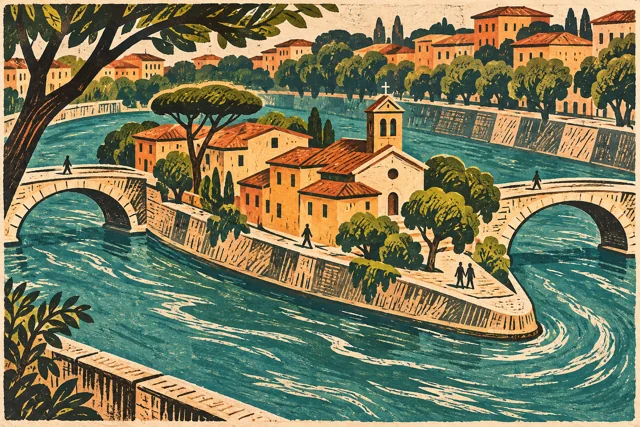
A visit pairs naturally with the walk around the Portico d’Ottavia, where the history of Jewish Rome deserves time of its own. If you have one more short stop in mind, follow the route toward Isola Tiberina and its bridges. For another day, the Fontanone on the Janiculum shows what a fountain can do with an enormous backdrop and a distant audience. Piazza Mattei achieves its effect across the width of a conversation.
If selecting a guided route from our Rome short-visit collection, look for Piazza Mattei in the actual stops or allow time to return independently. A walk through the district can easily use another street. Keep doorways and crossings clear when you pause. Before you leave, glance back from the mouth of a lane. For a moment the turtles shrink out of sight, and you can see how well the silhouette worked before they climbed into it.
Sources & further reading
Turn a good read into a great day.
Find a highly rated Rome experience that brings these stories to life.
Explore related experiences →