A Rome day built around the Ara Pacis and the river
A day centered on the Ara Pacis can give Rome a different rhythm. Begin with one monument and look carefully; take a break near the river; then choose whether you want another cultural stop or simply more time outside. The point is not to connect the greatest possible number of sights. It is to let a compact museum visit open questions about Roman imagery, modern collecting and the city around it.
This is a flexible framework rather than a timed route. Check the museum’s current opening information, ticket conditions and temporary notices before arranging the day. Decide on an optional second stop only after you know how much attention and energy the first visit requires.
Give the altar a historical starting point
The museum’s official introductory leaflet explains that the Senate decreed the altar in 13 BCE following Augustus’s return from Gaul and Spain. Its ancient setting was in the northern Campus Martius. That context is enough to begin asking how a public monument connected a particular political moment with a broader image of order.
You do not need to identify every figure immediately. First walk around the monument if the current visitor route permits it, noticing how its images are organized. Then choose one section for a slower look. A first circuit establishes the whole; the second lets a detail become more than something photographed in passing.
Read the plants as carefully as the people
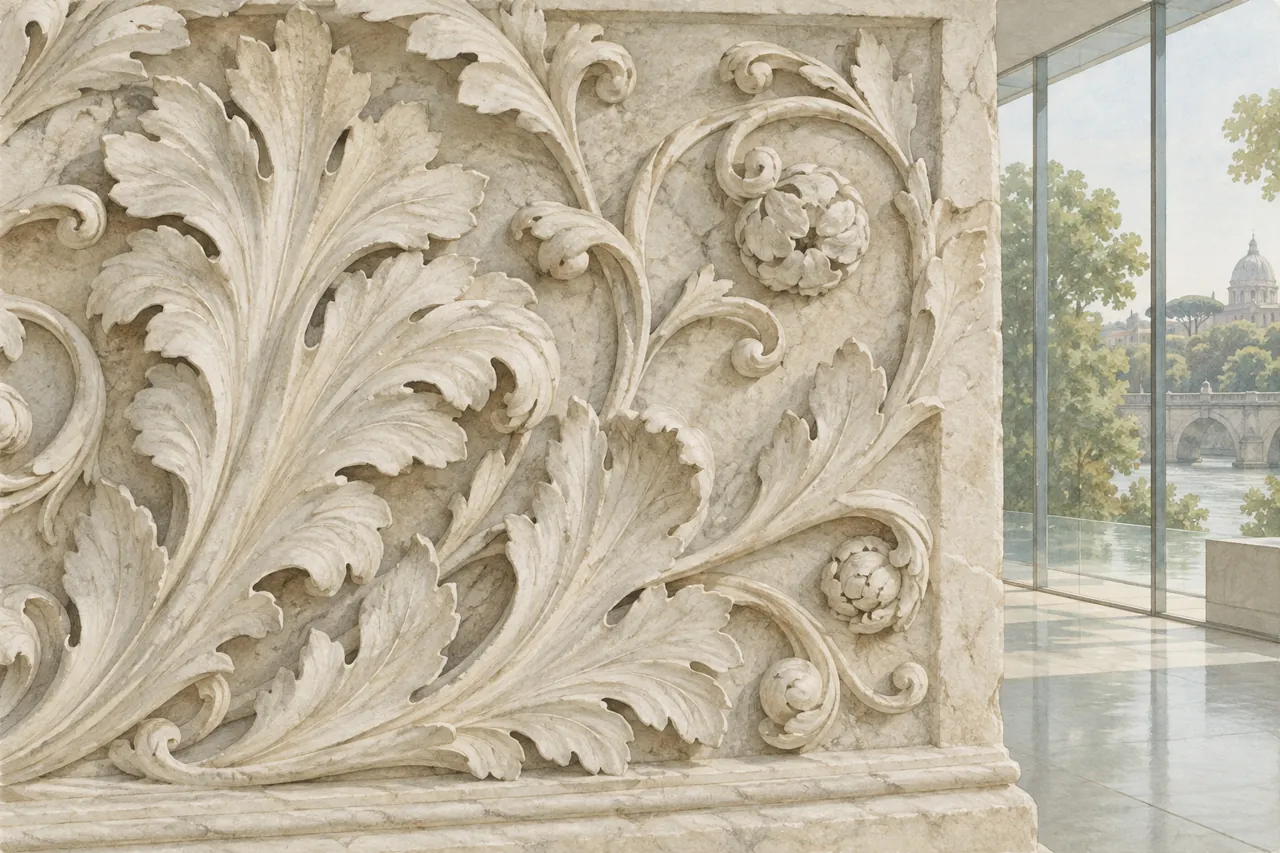
The museum’s account of the exterior decoration distinguishes a lower vegetal register from an upper figurative one, with mythological scenes near the entrances and processions along the sides. It also makes room for uncertainty: the identification of the processional occasion is debated. The carvings are rich evidence, but they do not hand visitors a completely settled caption for every question.
Try comparing the visual work done by foliage and by figures. Where do you notice repetition? Where does an individual gesture interrupt it? What draws your eye upward or along a panel? These are looking questions, not a claim that every ornamental curl has one secret meaning. They help you spend time with the carving before reaching for an explanation.
Traveling with a companion can make this especially enjoyable. Each person can choose a detail and explain why it caught their attention. A child might notice an animal or a hand; someone interested in design might focus on rhythm. The exercise works because it begins with observation, without requiring everyone to arrive with the same knowledge.
Ask how the monument reached this setting
The museum’s rediscovery history traces finds from the sixteenth century onward and excavation interrupted by concerns for the building above. The altar was reassembled near the Tiber in 1938, during Mussolini’s rule. The present location therefore belongs to the monument’s modern political and conservation history, as well as to a visitor’s experience of ancient Rome.
That is a useful moment to separate three stories: the ancient commission, the recovery of fragments and the later decision to display them here. Ask which story a label is explaining. A reconstructed monument is not less worth seeing, but understanding reconstruction changes the questions you bring to it.
The museum’s description of Richard Meier’s building emphasizes light and the protection of the monument. Notice how the surrounding architecture affects your attention without treating a changing reflection or view as an ancient feature. Our lead illustration combines relief and river imagery interpretively; it is not a record of a particular gallery viewpoint.
Use the river as a pause, with a flexible route
After the museum, decide whether you want a short walk at street level or a seated break. Choose a route appropriate to current conditions and your group’s mobility. Do not assume that a lower riverside path, staircase or crossing will suit everyone or be available simply because it appears on a map.
Our Tiber-centered evening guide offers another way to think about the river as part of a day. You can borrow its slower approach without turning a morning museum visit into an obligation to stay out until night. A pause can be the most useful transition between concentrated looking and the wider city.
Add one contrasting stop if you still want more
For a second architectural question, consider our guide to looking at the Pantheon’s dome. For a conversation about changing urban form, read how an ancient stadium became Piazza Navona. Check the actual route and access arrangements before choosing either; neither needs to be compulsory.
The arts and events collection can help you find a guided option suited to your interests. If Roman political imagery has become the day’s theme, save Colosseum Tour Hub’s Arch of Constantine looking guide for another outing. Comparing monuments is more rewarding when each has had its own moment of attention.
Sources & further reading
Turn a good read into a great day.
Find a highly rated Rome experience that brings these stories to life.
Explore related experiences →