Rome’s Keats-Shelley House: what does a literary room preserve?

The busiest part of a literary museum visit can happen before you enter it. At Piazza di Spagna, people are choosing photographs, meeting friends and working out which way the steps go. The Keats-Shelley House asks for a smaller kind of attention. Inside, a room, a letter or a portrait may become the centre of an entire conversation. You need not arrive knowing a shelf of Romantic poetry. A useful first question is simply this: what connects the thing in front of me to a writer’s life?
A place of residence, then a place of remembrance
John Keats spent his final months in this house and died in Rome in 1821. The museum opened in 1909, long after his lifetime. Those dates establish two histories: the history of a person living here and the history of people deciding how to remember him. The building’s location matters, but the museum is also a deliberately assembled collection. Its name does not mean that Keats, Shelley and every other writer represented shared this apartment.
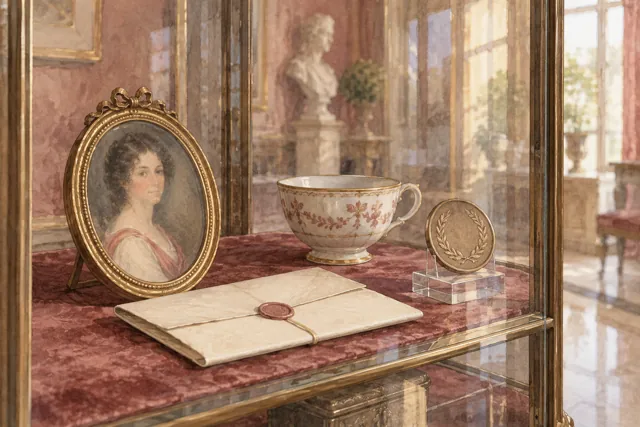
That distinction makes a visit richer. A portrait can show how someone was represented; a letter can offer a particular voice addressing a particular recipient. A later commemorative object reveals another generation’s attachment. These are different kinds of evidence. Instead of asking whether everything is “original,” ask what is original about each object: its material, its date, its connection to an individual, or its role in the history of the memorial.
Read one label before reading an entire life
Choose a manageable object rather than trying to absorb every name. Look first, then read its date, maker and description. Does the label identify handwriting, a reproduction, an association or a later likeness? If the relationship is not clear, leave it open rather than filling the gap with a pleasing story. A museum visit can accommodate uncertainty. In fact, a carefully worded label may be more interesting than a dramatic anecdote you cannot substantiate.
Now try a second object of another type. A book and an image might invite different questions about circulation and reputation. What could a contemporary reader have encountered? What has a later visitor been encouraged to imagine? These are suggested looking exercises, not a claim that the museum provides a particular activity sheet. They also work if a temporary arrangement means that an object you expected is not on display.
Give the room and the collection different jobs
Let the apartment establish scale: how does a small interior change your response after the public square? Let the objects establish specific connections. Avoid treating an evocative room as proof that every furnishing belonged to the poet. The pleasure of visiting is not dependent on freezing the house at a single moment. Its subsequent care, collecting and use as a literary institution are part of the story you have come to meet.
The museum’s present identity includes a library, research and cultural exchange. Ordinary admission should not be confused with an appointment to consult research material or attendance at an event. If either is your purpose, check the relevant programme separately. A visitor looking for literary atmosphere and a researcher looking for a document may arrive at the same door with quite different arrangements.
Plan for a small museum with a midday break
The official visit page checked on 22 October lists Monday to Saturday opening from 10:00 to 13:00 and 14:00 to 18:00, with last entry at 17:45. Advance booking is available but is not generally required for an ordinary individual visit. Confirm current notices before travelling, especially for holidays, group visits or events. A lunchtime arrival should be planned around the closure rather than treated as spare museum time.
The access description also deserves close reading. The museum level offers wheelchair access once reached, but the route to that level involves a flight of stairs. That is not a step-free arrival. Contact the house in advance with your own access requirements instead of relying on the word “accessible” in a general listing. Leave large bags elsewhere when practical and keep conversation considerate in the intimate rooms.
Continue the literary thread without crowding the day
For a different relationship between travel and writing, read our guide to Rome’s Casa di Goethe. The Non-Catholic Cemetery offers a separate, more contemplative context; it is not a convenient extension of the same building. Nearby, a short Piazza del Popolo walk can balance indoor concentration with open space.
Compare any guided option in our Rome experience collection by its actual itinerary and admission inclusions. If your travels continue to Tuscany, Florence’s Casa di Dante raises a related but different question about a reconstructed literary setting. For this visit, one carefully understood object is a better souvenir than a dozen untested stories.
Sources & further reading
Turn a good read into a great day.
Find a highly rated Rome experience that brings these stories to life.
Explore related experiences →