Rome’s Casa di Goethe: how can a literary museum change the way you travel?

A literary museum is an appealing interruption to a busy Rome itinerary: for a while, somebody else does the rushing around Italy. At Casa di Goethe, the useful question is not how many books you have read before arriving. It is how a traveler turns unfamiliar places into drawings, descriptions and memories. The museum gives that question a particular address, Via del Corso 18, in the building where Goethe stayed with the painter Johann Heinrich Wilhelm Tischbein during his Italian journey.
Follow one kind of evidence
Begin by choosing a letter, drawing or portrait rather than trying to absorb an entire biography. The permanent exhibition uses contemporary documents and Tischbein’s sketches to approach Goethe’s Roman life. Its subjects extend to color, plants and the encouragement he received to draw. That breadth is an invitation to curiosity, not a checklist of expertise. You can have a rewarding visit while knowing considerably more about your own train connection than eighteenth-century literature.
Try a small looking exercise. Before reading the explanation, decide what the object can actually tell you. A quick sketch might preserve a pose or a moment of attention; a letter addresses a particular reader. Neither provides an unfiltered recording of a whole life. Then read the caption and notice how your first impression changes. The enjoyable part is often that modest revision, when a seemingly ordinary detail acquires a purpose.
Separate the traveler from the later icon
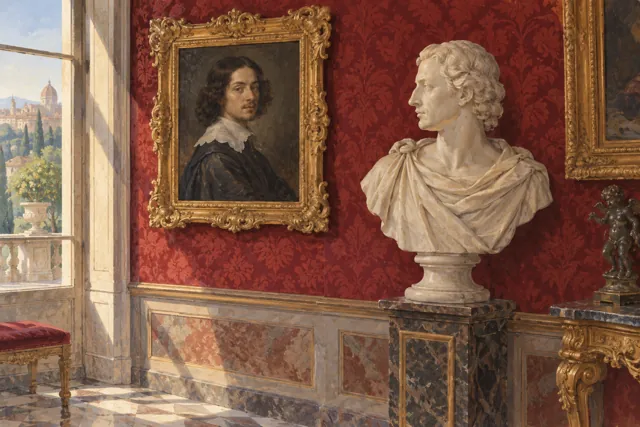
The museum also includes later responses to Goethe. Its permanent-exhibition page identifies Andy Warhol’s 1982 portrait and explains that a version of Tischbein’s famous image displayed here is a copy by Georgi Takev. This is a good place to resist the assumption that everything in a historic house belonged to its famous resident. An original document, a later portrait and a modern copy do different jobs. Their dates and makers are part of the experience.
The wider collection catalogue, with artists from different periods, reinforces that distinction. A literary reputation continues to be made after its subject’s lifetime. Ask whether a particular image shows a person at work, constructs a public identity or responds to an earlier picture. You do not need to settle the question. Comparing two possible readings is already more interesting than treating every portrait as a transparent likeness.
Let the museum improve your own notebook
There is a practical souvenir here that does not require the shop: a better way of recording your travels. After the visit, write three sentences about one place you saw that morning. Make the first a concrete observation, the second an interpretation and the third a question. Keeping those separate helps prevent memory from polishing uncertainty into fact. A crooked sketch can perform the same service; it records what caught your eye rather than pretending to replace the place.
For a related Roman encounter with objects and personal history, our guide to the Museo Napoleonico asks how family possessions shape a historical narrative. If Florence is also on your itinerary, the Casa di Dante guide offers a useful comparison: a literary museum can involve reconstruction and commemoration as well as an address associated with a writer. The two visits reward different expectations.
Plan the actual visit
Checked on 21 October 2026, Casa di Goethe’s visitor page lists Tuesday–Sunday opening from 10am to 6pm, with last admission at 5.30pm and Monday closure. It describes guided visits as requiring a booking and library access as appointment-only. Those are separate arrangements: a museum ticket should not be treated as permission to browse a research library. Recheck the official page for holiday closures and any exhibition-change arrangements before setting out.
Avoid selecting a visit solely from a future exhibition banner. The museum’s current homepage advertises a programme beginning in December; that does not make it available during an October trip. The permanent collection gives the visit its own purpose. If you have a specific work in mind, check whether it is on display, since collection ownership and continuous display are different things.
Give the surrounding streets some breathing room
A modest plan works well here: museum first, then the Piazza del Popolo area or a walk chosen from our Rome walking experiences. Check what any guided product actually includes; proximity to Casa di Goethe does not imply entry. Keep a pause between appointments instead of turning Via del Corso into a timed obstacle course.
Our four-day Rome outline can help spread larger museums across the trip. Casa di Goethe fits especially well when you want a change in scale: fewer grand rooms to conquer and more reasons to look carefully. Leave with one object or sentence still in mind. That is a perfectly substantial result from a small museum.
Sources & further reading
Turn a good read into a great day.
Find a highly rated Rome experience that brings these stories to life.
Explore related experiences →