Rome’s Palazzo Venezia: what can the garden reveal beyond the busy square?

Piazza Venezia can make a traveler feel that every possible direction contains traffic, a monument and somebody crossing the road with unusual confidence. Palazzo Venezia offers a different scale of attention. Its garden invites you to look inward, at the relationship between plants, walls and passages. You can approach it as a small architectural lesson even if a longer museum visit does not fit your day. The essential first step is to distinguish the garden from the palace’s various interior spaces.
Start with the parts you can actually visit
As checked on 21 October 2026, VIVE’s Palazzo Venezia page still carries a restoration-closure notice for the historic halls. A broad reference to completion in 2026 is not confirmation that every room has reopened. The official planning page distinguishes freely accessible areas, including the Giardino grande, from ticketed museum spaces. Check the current notices and the access offered for your date before buying or planning around a particular hall.
This distinction improves the visit rather than diminishing it. A garden stop and an extensive interior tour are different commitments. Decide which one you want, then verify the relevant entrance and conditions. Restoration visits, occasional openings and ordinary admission should not be blended into an imaginary all-access ticket. An old event page is evidence that an event happened, not that it remains bookable today.
Read the courtyard as a changing place
VIVE describes Palazzo Venezia as a fifteenth-century residence associated with Cardinal Pietro Barbo, later Pope Paul II, and subsequently with popes, ambassadors and other political occupants. Its garden has a later history: the original courtyard acquired its planted character during the nineteenth century. That chronology makes a useful looking prompt. The greenery is not simply an unchanged Renaissance backdrop; it belongs to the building’s continuing adaptation.
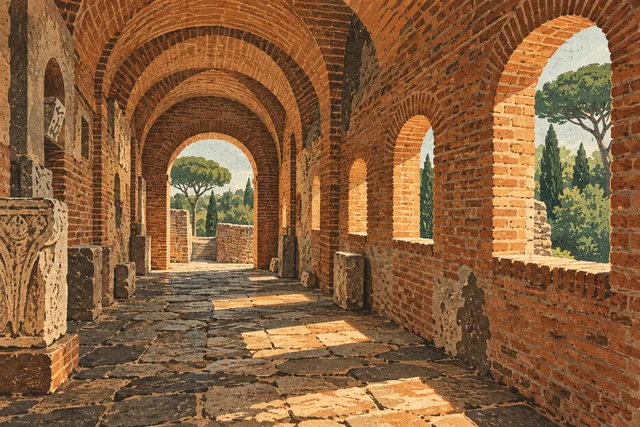
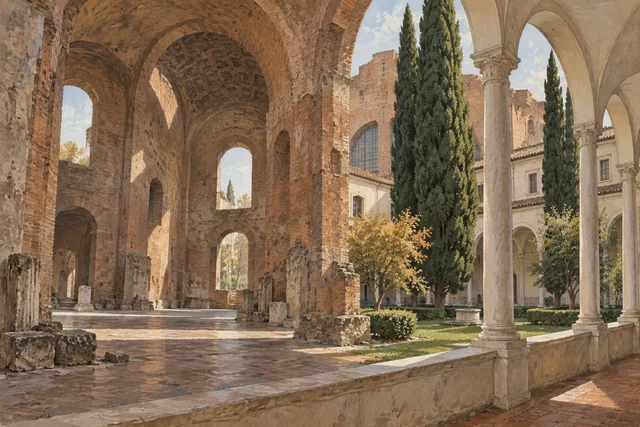
Stand where you are permitted to pause without obstructing an entrance. Compare the repeated architectural openings with the irregular edges of foliage. Notice how shade alters the apparent depth of an arcade. These observations do not require you to identify every stone. They make the difference between using a courtyard merely as a shortcut and recognizing it as a carefully shaped space with several periods of life.
Let one feature lead the investigation
The official garden account identifies a central fountain commissioned in 1730 by the Venetian ambassador Barbon Morosini, representing Venice’s marriage to the sea. It also points out the neighboring fabric of San Marco on the eastern side. Those details turn the garden into a meeting place of political associations and different architectural dates. You can look for the relationships without assuming that all visible elements were conceived together.
A useful exercise is to choose one feature and ask three simple questions: what does it depict, who commissioned it, and why is it here? The answer may require a caption or the official guide. If you cannot establish it, keep the question open. There is no prize for inventing a convincing story about an unfamiliar coat of arms, and a good unresolved question often makes the next museum visit more engaging.
Connect it with other Roman palaces
Our guide to the Doria Pamphilj Gallery explores how a palace changes the experience of looking at portraits. At Palazzo Altemps, the emphasis is on the decisions made by collectors. Palazzo Venezia adds another possibility: reading a substantial building through its exterior and open space when access to interiors is limited. These approaches can complement each other without requiring three palace visits on the same afternoon.
For a different city’s example of rooms becoming part of a museum, see Bologna’s municipal art collections. The comparison is about how buildings frame what we see, not an assertion that their histories or access arrangements are equivalent. Every institution has its own collection, conservation requirements and practical rules.
Keep the practical plan small enough to enjoy
Allow time to find the current entrance and read any local notices. Piazza Venezia’s surroundings can be affected by works and temporary arrangements; follow the signed pedestrian route rather than a straight line drawn on an old map. Before choosing a longer visit, check step-free access to the specific spaces you intend to see. A generally accessible complex does not automatically make every room or temporary route equally accessible.
If the garden is your pause between larger visits, our Capitoline Museums introduction offers a nearby cultural focus for another part of the day. Compare Rome history experiences by their stated itinerary and admissions, especially when a product mentions a square without promising palace entry. Leave enough time to return to the garden’s basic pleasure: noticing how a bounded piece of greenery can change your experience of the surrounding city.
Sources & further reading
Turn a good read into a great day.
Find a highly rated Rome experience that brings these stories to life.
Explore related experiences →