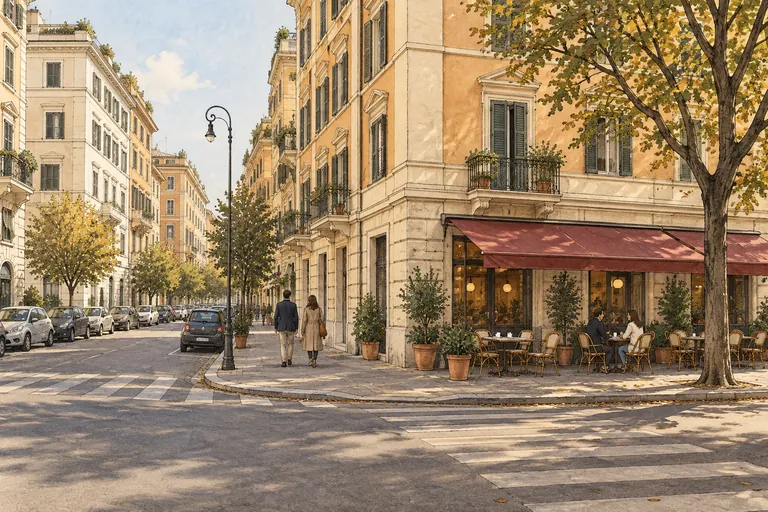
How did EUR give Rome a different architectural vocabulary?

EUR shows a different Rome: large geometric buildings, broad views, planned open spaces and a history that belongs to the twentieth century. It is a useful choice when you want to understand how the capital continued to reinvent itself after the eras most sightseeing routes emphasise. Approach it with curiosity about architecture and with attention to the political setting in which the district began.
You do not need to turn the outing into a tour of every landmark. Choose a small group of buildings or one museum as your anchor, then leave room to notice the spaces between them. Our guide to a Rome trip beyond ancient Rome explains how a contrasting district can give a longer stay a more varied rhythm.
Understand the exhibition that never opened
Turismo Roma’s account of EUR explains that the district was planned for the 1942 Esposizione Universale Romana, which did not take place because of the Second World War. Its architecture carried the symbols and ambitions of the Fascist regime. Those origins matter. Looking closely at an impressive facade need not mean accepting the political message for which it was commissioned.
Try asking two questions together: “How does this building create its effect?” and “What was that effect meant to achieve?” Repetition, scale and symmetry are visual choices, but in this setting they also belong to a public presentation of power. Keep the distinction between appreciation and approval clear. A thoughtful architectural visit can accommodate both a strong visual response and a critical historical reading.
Look at repetition without reducing the district to a nickname
The Palazzo della Civiltà Italiana is often called the “Square Colosseum.” The municipal tourism account identifies its travertine mass and arched form as an emblem of the area. Use the nickname as a starting point, not an explanation. Notice the regular arrangement of openings, the building’s overall volume and the way light gives depth to otherwise repeated elements.
For an instructive contrast, read the Colosseum specialist’s history of the ancient amphitheatre. A borrowed visual association does not make two buildings equivalent in date, purpose or construction. Your eye may recognize an arch immediately, while the historical explanation needs to be more precise. That tension is part of what makes the comparison worthwhile.
Pay attention to the distance between things
In some parts of central Rome, the pleasure of a walk lies in tightly packed corners and unexpected turns. At EUR, make room in your observation for longer sightlines and the relationship between a building and its open surroundings. Watch how your impression changes as you approach. A facade that looks like a pattern from far away can become a sequence of deep shadows at a closer, permitted viewpoint.
Do not confuse a broad visual connection with a short walking route. Check pedestrian crossings, distances and places to rest before setting out. A map helps you avoid a plan that looks elegant on paper but leaves someone in your group tired halfway through. Our Rome transport guide gives a method for checking the actual journey rather than relying on an old timetable.
Give the district more than one date
Turismo Roma also describes today’s EUR as a residential and office district with green spaces, including its lake, alongside later buildings such as La Nuvola. This is a living part of Rome, not a sealed exhibition of one historical moment. Notice ordinary uses too: where people pass through, pause or go to work. Architecture continues to acquire meaning through the activities around it.
A useful comparison is Garbatella’s neighborhood story, which encourages a different way of reading streets and housing. You can make that comparison across separate days. There is no prize for covering every modern district in one afternoon. A narrower visit often gives you enough mental space to notice the differences that an overfilled route would flatten.
Choose an indoor anchor only after checking access
If you want to include a museum or exhibition, confirm its current opening arrangements and which collection or rooms your ticket covers. A building’s presence on an architecture itinerary does not mean its interior is freely open. Treat an exterior walk and an exhibition visit as separate choices. Keep a weather alternative ready if the main interest of your plan is outdoors.
Our walking experiences can help you compare guided options, but read the named district and meeting point carefully before booking. Finish by choosing one feature you would recognize again: a repeated arch, a long view or the contrast between built mass and open space. EUR becomes easier to remember when you give it its own visual vocabulary, alongside the older chapters of Rome.
Sources & further reading
Turn a good read into a great day.
Find a highly rated Rome experience that brings these stories to life.
Explore related experiences →