A thoughtful walk through the Quartiere Coppedè
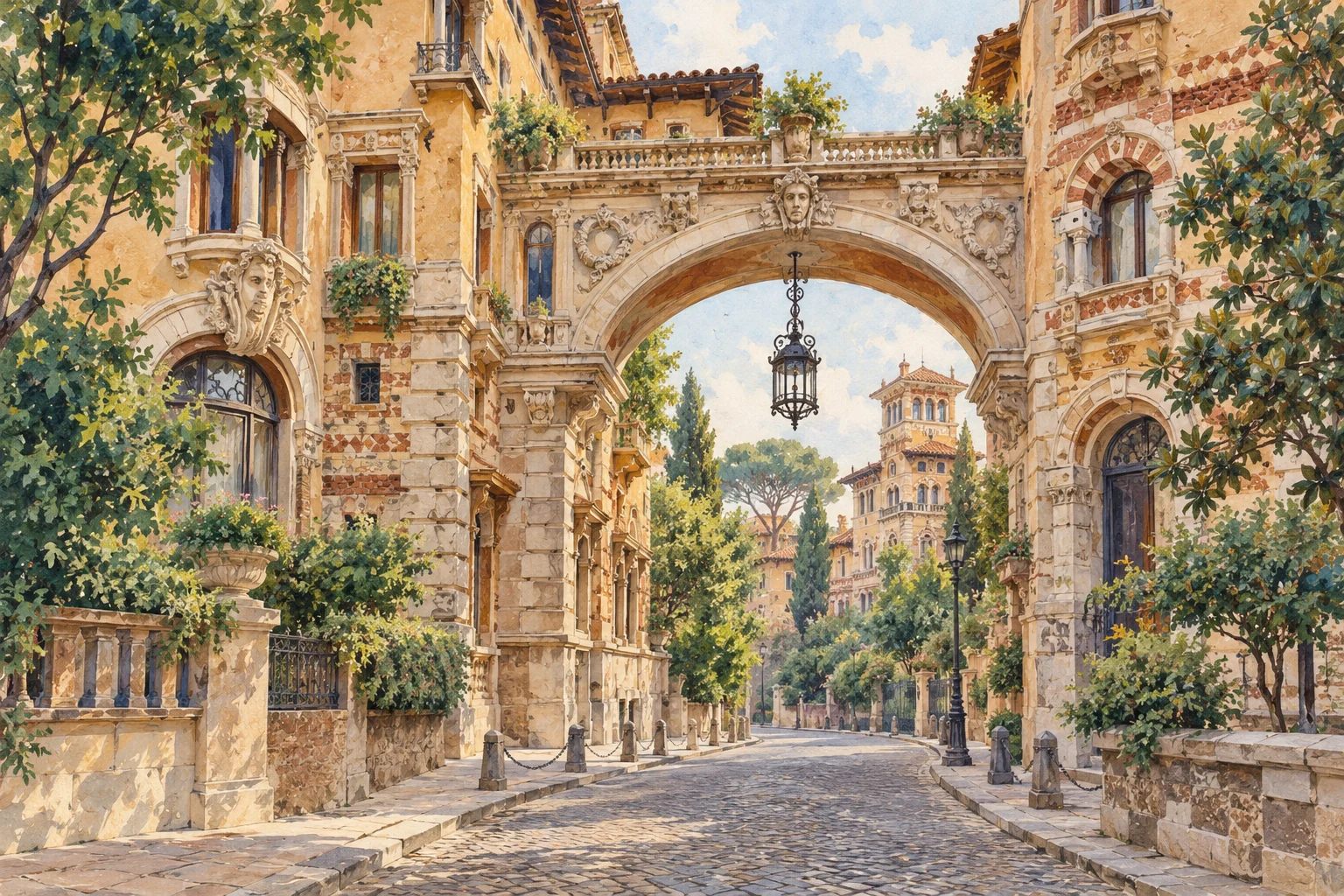
The Quartiere Coppedè is a small area with a very large appetite for ornament. An arch can feel like a stage entrance, a residential facade like a collection of architectural quotations. Its pleasures are concentrated enough for an unhurried walk, provided you treat it as a lived-in part of Rome. You are looking from public streets at buildings where people conduct ordinary lives, not entering an outdoor attraction with unrestricted access.
Give the outing a simple theme: how can a building make you slow down? There is no need to identify every borrowed style. Notice a shape, compare it with its neighbor, and leave enough room on the pavement for someone who is simply trying to get home. This approach also works in our Garbatella neighborhood guide, although the two areas tell very different stories.
Begin at the gateway, without turning it into a doorway queue
Rome’s official tourism account dates the project by Gino Coppedè to 1915–1927 and identifies the richly decorated arch connecting the Palazzi degli Ambasciatori. A large iron lamp hangs beneath it. This is twentieth-century architecture drawing on several earlier visual languages, not an intact medieval quarter that somehow escaped the rest of the city.
Approach from the public street near Via Tagliamento and Via Dora, checking crossings as you go. Before moving beneath the arch, look at the relationship between its opening and the buildings on either side. Does it feel like an entrance to one property or to an entire scene? The question is about what the design suggests; it does not change which spaces are private.
Photograph from a safe position that does not obstruct access. You can make one picture of the whole gateway and a second of a chosen detail, then put the camera down. Looking through a screen continually makes it harder to understand how the space changes as you move.
Use Piazza Mincio as a place to compare
The city’s Trieste–Salario guide places Piazza Mincio at the center of the ensemble, with the Fountain of the Frogs among its distinctive features. Pick two surrounding facades and compare their outlines before examining their decoration. Look for a difference in roofline, window rhythm or the balance between solid wall and opening.
Try this with a companion: each person chooses one detail without naming it, then describes it well enough for the other to find. “Near the upper window, with a curved outline” is more useful than “the interesting thing.” The game turns observation into a shared activity and keeps the walk from becoming a silent sequence of photographs.
The city’s restoration account of the fountain is a reminder that ornament needs maintenance. Appreciate the forms from the public viewing space; fountains are not seating, climbing or bathing installations. A decorative animal is also not automatic evidence for a secret code. If a symbolic interpretation interests you, ask for its source and distinguish a documented design history from an entertaining legend.
Read a residential street at residential speed
After the square, choose one short outward-and-back stretch rather than wandering into every entrance that looks inviting. A gate being open does not make a courtyard public. Keep conversations low near windows, leave doorbells alone and ask permission before photographing residents at close range. The architecture rewards attention without requiring access to private interiors.
You might notice a contrast between large decorative gestures and very ordinary objects: a drainpipe, a door handle, an intercom. That contrast helps keep the place in the present. It is tempting to describe the whole area as a fantasy, but people do not live in a metaphor. A respectful walk allows both the dramatic design and everyday use to remain visible.
Plan the journey, then choose just one addition
Check the current route from your actual starting address, not only from the general historic center. Our Rome public-transport guide explains why the final walk and return connection belong in the plan. If anyone needs level surfaces or frequent seats, assess the particular streets and crossing points rather than relying on a general neighborhood description.
An afternoon need not contain a second major attraction. A seated break may be the right ending, especially after a morning museum. For a separate park-focused day, use our Villa Borghese planning guide. Travelers continuing to Florence can compare these deliberately eclectic facades with the coordinated public setting in Florence’s Piazza della Signoria.
Browse Rome walking experiences if you would like help interpreting buildings, checking the named route before booking. A city-wide highlights walk does not necessarily visit Coppedè. The most satisfying outcome here is modest: one architectural surprise you can describe, and a neighborhood you have enjoyed without taking it over.
Sources & further reading
Turn a good read into a great day.
Find a highly rated Rome experience that brings these stories to life.
Explore related experiences →