Rome’s Villa Doria Pamphilj: how do you plan a park visit without chasing every landmark?

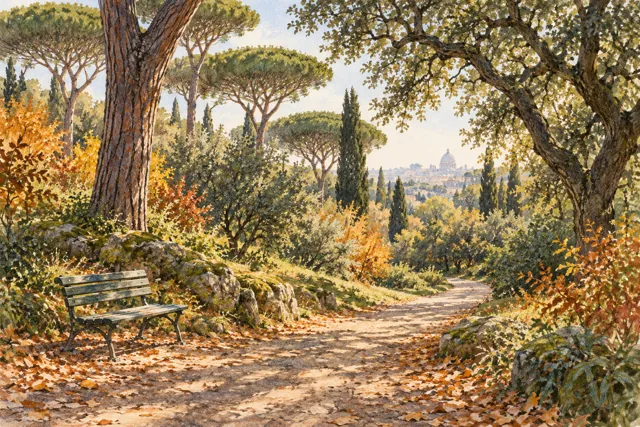
A large park is most restorative when it is allowed to remain a park. Villa Doria Pamphilj can become surprisingly tiring if you arrive with a list of every fountain, building and named garden, then spend the afternoon checking your phone to find the next one. A better first visit begins with a modest decision: choose an entrance, a comfortable amount of walking and one thing you would enjoy noticing. The landscape has enough history to reward curiosity without requiring a military campaign.
Choose the park you mean to visit
Villa Doria Pamphilj is the extensive historic park in the Monteverde–Gianicolense area. It is not the Doria Pamphilj Gallery in central Rome. Sharing a family name does not make the two places interchangeable. Check the exact map location before arranging transport or meeting friends; a booking for a palace gallery will not deliver you to a meadow under umbrella pines.
The municipal heritage description distinguishes a more monument-rich eastern sector from a more naturalistic western one, separated by Via Leone XIII. That is useful orientation, not a demand to cover both. If buildings and formal landscape interest you, choose a modest route accordingly. If your aim is a pause between museums, let shade, seating and a manageable return decide the outing. Save your chosen entrance on the map and identify an exit suitable for the journey afterward.
Notice how a garden directs movement
The official garden history describes several different designs rather than one unchanged composition. The Giardino Segreto uses formal planting and an enclosed arrangement beside the Casino; the Giardino del Teatro acquired a more landscape-like character during the nineteenth century. You need not enter every named space to appreciate the distinction between straight lines that organize a view and curving paths that reveal it gradually. Use the public paths available on the day, respecting gates and barriers.
Try a simple observation exercise. Stop where a path changes direction and ask what becomes visible. Does a tree interrupt a long view? Does an open patch make the next shaded section feel more enclosed? These are ways to read a designed landscape without pretending that every present-day branch follows an old plan. Weather, maintenance and plant growth continue to alter gardens. A historic park is a living place, with repair work and ordinary wear as well as heritage.
A building in a public park is not automatically open
The Casino del Bel Respiro has a separate institutional role connected with the Presidency of the Council of Ministers. The heritage authority’s building account also identifies different histories and ownership arrangements within the estate. Do not convert a description of an interior into an assurance that you can walk inside. An exterior view can be the whole intended stop; any special opening needs its own current official confirmation. Park entry and building access are different questions.
This distinction is especially helpful when comparing pictures online. A photograph of a formal garden, a reception room or a private event may have been made under conditions unavailable to ordinary visitors. Plan around the accessible outdoor route rather than a spectacular image. If there is one feature you particularly want to see, check its current access before leaving your accommodation, and keep an alternative that works without it. That leaves disappointment less room to organize the afternoon.
Build comfort into the route
Carry drinking water and choose footwear for park surfaces rather than only city pavements. After rain, a route that looks pleasantly short on a map may feel less comfortable underfoot. For mobility needs, check the particular entrance, slopes and surface conditions with current local information; the word “park” does not guarantee a uniformly step-free circuit. With children, decide on a turning point before anyone is tired. A pause to inspect pinecones can be a perfectly successful destination.
The municipal listing gives daytime opening tied to sunset, so check the current gate notice and leave a generous return margin. An autumn afternoon has fewer usable daylight hours than a summer one. Keep phones charged for navigation, but avoid spending the entire walk staring at the route. If transport planning is the awkward part, our Rome public transport guide helps you separate the outward and homeward journeys.
For another green-space mood, compare Villa Ada’s woodland approach; for a more formal garden visit on a different Italian city stay, see Florence’s Boboli Gardens. Our Rome walking experiences are useful when you want a guided route, but check the actual itinerary rather than assuming this park is included. Finish with enough energy to enjoy the rest of the day: one good loop often teaches more than a hurried collection of landmarks.
Sources & further reading
Turn a good read into a great day.
Find a highly rated Rome experience that brings these stories to life.
Explore related experiences →