Which arches are you seeing in Rome’s Parco degli Acquedotti?

From the edge of Rome’s Parco degli Acquedotti, an aqueduct can look like an exceptionally long bridge waiting for its road. Follow its top edge instead. A channel had to carry water across changes of ground level while keeping a gentle fall. The wall of arches is the part of that job that rises into view. Across the grass you can see evidence of more than one solution, built many centuries apart, without attempting an all-day hike along the Appian Way.
Choose a neighborhood entrance
This is the Acquedotti area of the regional Appian Way park in southeast Rome. Put an entrance in your navigation app. A search for the whole regional park may send you to another district entirely. The park authority lists several approaches from Via Lemonia, including the area of Piazza Aruleno Celio Sabino. Metro A’s Giulio Agricola and Subaugusta stations serve that side. There is also an entrance from Viale Appio Claudio. Match the gate to the station you intend to use on the way back. Regional park directions by area.
Save the Acquedotti map while you have a connection. It shows more than the aqueducts and helps explain why a straight line on the skyline does not translate into a straight walking route. Streets, the railway and the edge of the open land matter on foot. If you are arriving independently from the centre, our guide to Rome’s metro and buses can help you allow for the transfer and the walk from the platform before you start counting park time.
Look for two heights
The regional park identifies the tall arcade of the Acquedotto Claudio and the lower Acquedotto Felice. The former belongs to the ancient supply network. The latter is a papal project of the Renaissance, and the park says its water still serves irrigation. Seen from far enough away, the pair can look like two ages of the same ruin. The lower line is evidence of a later city deciding that this corridor was still a good place to bring in water. The regional park’s Acquedotti itinerary.
Try standing where you can fit the ground and the top of an arch into the same view. Now look along a sequence of openings. The openings change size in your field of vision much more dramatically than the top edge changes height. That is perspective at work. Resist trying to guess the direction of the flow from a single photograph taken at an angle. What you can confidently see is the extraordinary length over which somebody had to control a channel’s level.
Make a short walk do more
On a first visit, follow one public path far enough to change your angle on the arches, then retrace it. Facing the other way lets the neighborhood reappear behind the open land. Give someone in your group the map and someone else the task of spotting where a second structure becomes visible. Switching jobs on the return is more rewarding than sending everybody in search of the same perfect photograph.
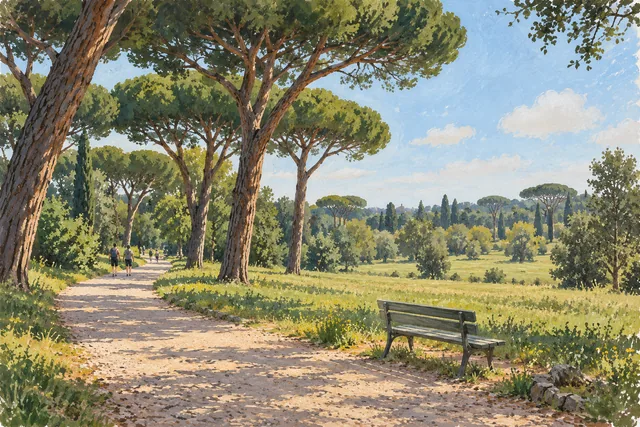
The grassland is part of the experience. An open stretch that feels inviting on a cool morning can be uncomfortable in strong sun or when rain has softened the ground. Bring water, choose footwear for earth paths and decide on a turning point while the trip back still sounds pleasant. If the pleasure you want is a shaded woodland ramble, Villa Ada offers a different landscape. If an organized walk appeals, use our walking tour collection to check the named park area and meeting location before committing.
Follow the water into town on another day
A useful comparison is Acqua Paola’s monumental fountain on the Janiculum. In the meadow, long-distance water supply is visible as a line in the landscape. At a monumental fountain, the endpoint takes the form of a public announcement. They are different systems and separate outings, but each makes the other easier to understand. One reveals the engineering distance, the other the civic ambition attached to getting water to people.
For an urban example in which a water channel and a busy junction share the same structure, our sister publication explains the aqueduct crossing at Porta Maggiore. Back at the park gate, see if you can still pick out the tall Claudio and the lower Felice from memory. Once you have those two lines straight, the meadow holds both ancient Rome and its Renaissance successor in a single view.
Sources & further reading
Turn a good read into a great day.
Find a highly rated Rome experience that brings these stories to life.
Explore related experiences →