Rome’s Villa Sciarra: how do you read a garden assembled from different histories?

A garden can tell its story through a curve in a path as effectively as through a grand entrance. At Villa Sciarra, on the Gianicolo side of Rome, plants, sculpture and changing ownership invite that slower kind of attention. You need not arrive with a list of every fountain. A better starting question is how things made in different places and periods have been arranged to feel like a single landscape.
Recognise a designed setting
The civic heritage authority describes a site transformed by successive owners, with a major early-twentieth-century reshaping by Giorgio Wurts and Henrietta Tower. Their scheme sought the atmosphere of an Italian Baroque villa. That matters because the garden is not an untouched survival from one distant moment. Its apparent age is partly the result of later collecting, planting and design decisions.
Among those decisions was the installation of eighteenth-century sandstone sculpture brought from the Visconti property at Brignano d’Adda in Lombardy. The figures therefore have histories beyond Rome. A sculpture’s present setting and its original setting are different kinds of evidence. Look at how greenery frames an object today without assuming that this is the landscape for which its maker first intended it.
Follow one relationship between stone and planting
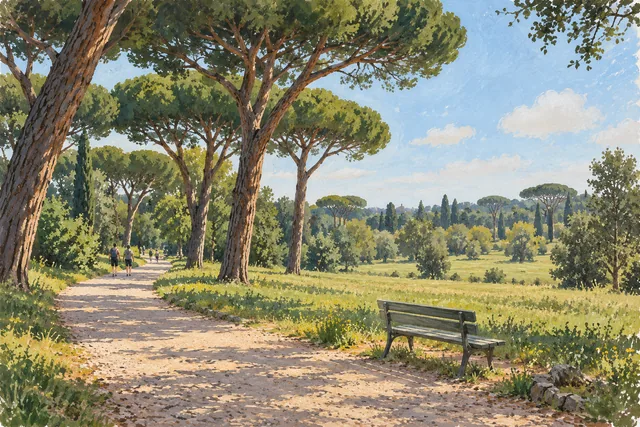
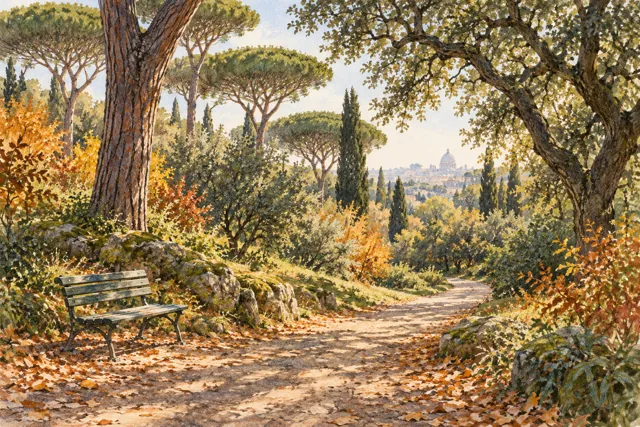
Choose a permitted stretch of path and notice what becomes visible as you move. A dense hedge may hide the next turn; a gap may suddenly reveal a sculptural group or a brighter patch of sky. You are observing the current arrangement, which can change with maintenance and seasons. That is more useful than trying to recover an exact historical view from imagination.
The official descriptions connect several sculptural subjects with seasons, rural activity and mythological figures. Read a label or reliable guide before assigning a name to an unfamiliar body or animal. You can still enjoy the contrast between pale stone and dark foliage without solving every identity. A useful family game is to describe one visible gesture and then compare interpretations, keeping guesses separate from identification.
Understand why restoration belongs to the story
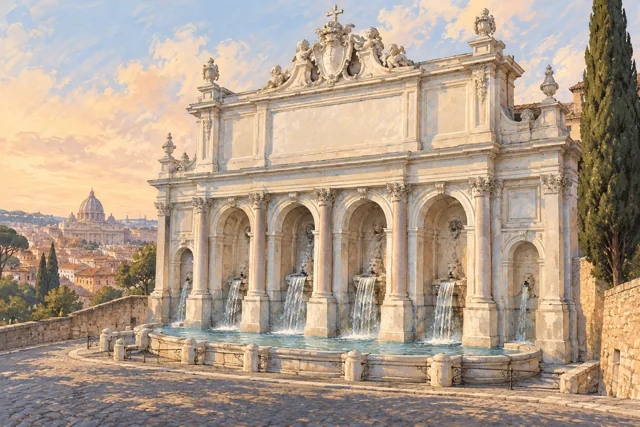
The heritage page records restoration work on fountains and sculptural furnishings completed in July 2025. This is evidence of care, not a promise that every fountain is flowing on the day you arrive or that every section of the park is accessible. Follow current signs and barriers. A temporarily quiet basin can still reveal shape, material and the way an object directs attention through a garden.
Our Acqua Paola fountain guide examines a very different kind of water monument. Comparing the two can sharpen the distinction between a public architectural statement and a garden feature encountered along a path. Neither needs to win a beauty contest. Their different settings give them different jobs.
Plan for daylight and the approach
As checked on 25 October 2026, the civic page gives ordinary opening from seven in the morning until sunset. Sunset is a moving boundary, especially as autumn progresses, rather than a fixed late-afternoon appointment. Check current municipal notices before travelling, leave time to find an open exit and avoid building the visit around the last minutes of light.
The authority lists entrances on Via Calandrelli, Via Dandolo and Via delle Mura Gianicolensi, recommending the Calandrelli or Mura Gianicolensi approaches for disabled access. That recommendation does not establish that every path or slope will suit every visitor. Ask about the particular route, surface and resting opportunities you need. Wear shoes appropriate for a garden and adjust the plan after rain.
Separate the park from the buildings
The Casino Barberini is associated today with the Istituto Italiano di Studi Germanici. A public park surrounding an institutional building does not make its interiors, research rooms or events freely accessible. Check an institution’s own arrangements if that is your interest. For most visitors, the garden itself provides a satisfying focus without adding an unconfirmed interior visit.
For another green-space outing, our Villa Doria Pamphilj guide concerns a different park and should be planned separately. Our Museo della Repubblica Romana article offers historical context for the wider Gianicolo area. Compare Rome walking experiences by their actual routes before assuming Villa Sciarra is included.
If you enjoy asking how a planted landscape stages a view, Florence Tour Hub’s Bardini Garden guide offers a useful later comparison. Leave Villa Sciarra with one remembered relationship—a shadow against stone, a hidden bend, a garden object given a new home—and you will have something more durable than a hurried checklist.
Sources & further reading
Turn a good read into a great day.
Find a highly rated Rome experience that brings these stories to life.
Explore related experiences →