Rome’s Palazzo Massimo: how do you look at a painted room?

A painted wall asks something different of you from a picture in a frame. It can surround your body, suggest a view where no window exists and quietly tell you where to stand. At Rome’s Palazzo Massimo, try making the room your first subject. Before searching for a celebrated detail, notice the relationship between the decoration, the floor and your own position. This is a pleasantly practical way into ancient art: you already know what it feels like to enter a room.
Start with the setting, then the image
The museum’s account of its paintings and mosaics explains that decorative cycles from Roman residences are displayed in settings that suggest the rooms from which they were removed. These are museum arrangements containing ancient surfaces, rather than intact houses transported into a palace. Keep both parts of that sentence in mind. The arrangement helps you imagine spatial relationships; the labels explain what survives and where it came from.
Make a first circuit without trying to identify every motif. Look for a horizontal band, a repeated division or a change of colour. Does it lead your eye around the space, bring it to a stop or create a sense of depth? On a second circuit, choose one small feature. A bird or a leaf becomes more interesting when you have noticed the larger visual rhythm that gives it a place.
What does the garden do?
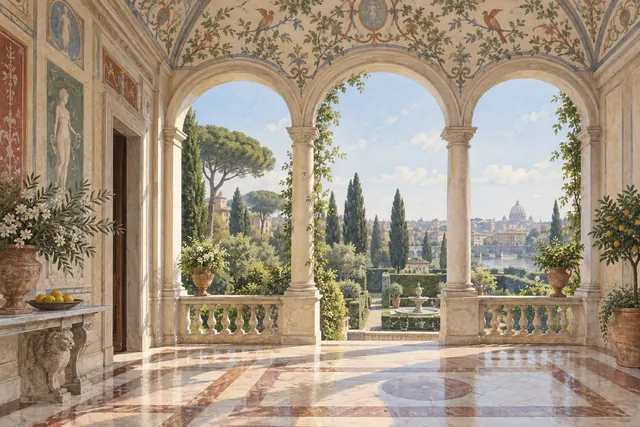
The painted garden from Livia’s villa on the Via Flaminia decorated a dining room. The museum identifies Livia as the wife of Augustus. Those facts provide a starting point, not a script for inventing a particular dinner. Ask how a garden image changes an enclosed space: does the eye move towards a boundary, through it, or across a continuous field of vegetation? Treat your answer as your observation, rather than a recovered ancient guest’s exact reaction.
Try a small looking exercise. Pick one patch of foliage and describe it without using “beautiful.” You might notice density, contrast, spacing or the way one form overlaps another. Then step back and see whether your detail still attracts attention. This is useful even if you cannot name the plant. Identification and visual analysis are different pleasures, and neither requires you to pretend to know more than you do.
Keep two Farnesinas separate
Palazzo Massimo also presents decoration from the ancient Villa della Farnesina beside the Tiber. This is not the same visit as the Renaissance Villa Farnesina with its painted rooms. Similar names can conceal very different periods and places. Write the museum name beside the object in your notes; your future self will appreciate the favour when sorting photographs.
Compare a garden-like expanse with a more architectural painted division. Which encourages a broad sweep of the eye, and which asks you to follow smaller compartments? You do not need to rank them. A comparison is most useful when it reveals a different solution to the same problem: making a wall do more than merely close a room.
Let the floor join the conversation
Mosaics and coloured inlay deserve a pause rather than a quick downward glance. Look for the scale of a pattern and the edges that organise it. A detail photographed close up may look almost abstract; its position within a room can make it feel architectural. Our archaeological specialist’s guide to reading a Roman mosaic develops that distinction for visitors moving between museums and excavated sites.
Leave yourself enough energy for this slower looking. Pair one floor or theme with a break instead of treating every room as another task to complete. If your interest is in the later presentation of antiquities, Palazzo Altemps and its collectors offers a useful separate visit. For another approach to Roman buildings with later lives, read our Baths of Diocletian guide.
Plan a museum visit, not an imagined time slot
Use the official Palazzo Massimo page to check current access, ticket arrangements and room notices before travelling. Notices for another Museo Nazionale Romano venue do not automatically describe this one. Compare the scope of any option in our Rome art experience collection; admission, meeting points and guiding depend on the specific listing. Once inside, give yourself permission to finish with one room understood a little better. That is a substantial souvenir, and it fits comfortably in your head.
Sources & further reading
Turn a good read into a great day.
Find a highly rated Rome experience that brings these stories to life.
Explore related experiences →