Rome’s Galleria Spada: how does Borromini’s perspective trick the eye?

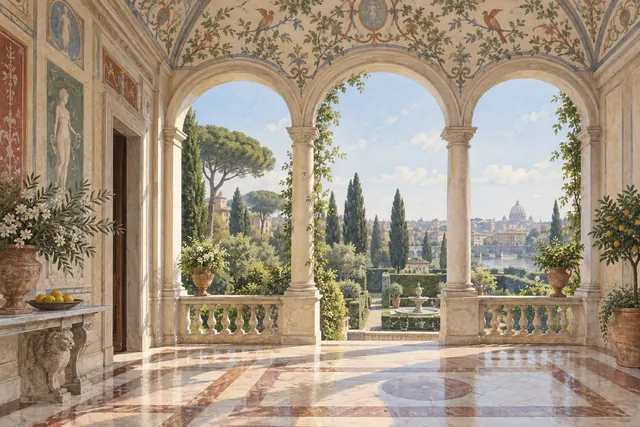
Galleria Spada offers a particularly enjoyable kind of museum surprise: your eyes can understand an illusion and still fall for it. A colonnade appears to extend much farther than it really does, drawing attention toward a figure at the end. The pleasure is not just being fooled. It is discovering how an architectural setting can guide your expectations, then noticing those expectations at work elsewhere in Rome.
Give the perspective time, but avoid making it the entire visit before you arrive. The palace is also an art gallery with a distinctive historical arrangement. If you enjoyed thinking about pictures in their setting in our Villa Farnesina guide, Spada offers another chance to consider how a room changes the way art is experienced.
Look once before reading the explanation
The museum’s official account dates the perspective to 1653 and identifies Francesco Borromini as its architect, assisted by the Augustinian Giovanni Maria da Bitonto. Cardinal Bernardino Spada commissioned it. The present figure at the far end belongs to a later change: a painted woodland backdrop originally closed the view, and a small warrior statue was introduced in the nineteenth century.
First look from the visitor position indicated by staff or signs. Describe your immediate impression without checking a measurement: long, short, grand, intimate, open or compressed. Then read the explanation and look again. The difference between those two moments is the lesson. You do not need to walk into restricted space or recreate a social-media pose to enjoy the effect; the permitted viewpoint is part of a responsible visit.
Ask what your eye is assuming
Rome’s official explanation identifies four cooperating devices: the floor rises, the ceiling descends, the side walls converge and the columns become progressively smaller. Together they compress a passage measuring a little under nine metres into a view that seems more than thirty metres deep. The apparent distance is an effect on perception, not a second physical measurement of the building.
Your eye normally uses the shrinking appearance of repeated, similarly sized things to judge distance. Here, the objects really shrink as well. The converging surfaces reinforce the same message, while the figure at the end helps establish a misleading sense of scale. Knowing the method does not make the illusion disappear; it lets you recognize how several modest changes cooperate to produce one emphatic impression.
With children, try a friendly prediction game: everyone quietly estimates the depth, then compares impressions after reading the panel. The aim is not to reward whoever guessed correctly. It is to discover that perception makes quick decisions from familiar patterns. Adults are just as susceptible, which is one reason this stop can be more fun than a solemn lecture about artistic genius.
Notice the collection’s arrangement
The museum describes its collection as remaining in the palace’s original rooms, where paintings are arranged in dense sequences with furnishings and sculpture. Four first-floor rooms preserve the character of a historic collection rather than a modern display of isolated pictures against generous blank walls. That arrangement is worth noticing as a subject in its own right.
Choose a small group of works that you can see comfortably. Compare scale, frames and the direction of figures’ gazes. Ask which picture catches your attention first and whether a neighboring work changes that choice. You can have a satisfying encounter with a historic collection without identifying every artist. Give one painting a full minute, then step back to see how the room gathers it into a larger display.
Make a compact art day, not an obstacle course
Spada can suit a focused visit, but plan around current opening information, the access route and your group’s needs. A historic palace should not be assumed to have the same circulation or step-free arrangements as a newly built museum. Check the museum’s own visitor information before booking a tightly timed sequence elsewhere, and leave room for the practical business of entering and finding your way.
For another gallery choice, read our comparison of Palazzo Barberini and Galleria Corsini. If you would rather end outdoors, Piazza Navona’s layered history offers a different lesson in how space shapes experience. Browse Rome art and cultural experiences, checking whether museum admission is actually included. Archaeology-minded travelers can continue the theme of persuasive public design with Colosseum Tour Hub’s Arch of Constantine looking guide. Before you leave, compare your first impression of the perspective with one detail from the collection. Which encounter asked you to move, and which rewarded standing still? That distinction can help you choose the pace of your next museum visit. The best souvenir from Spada may be a slightly more curious pair of eyes.
Sources & further reading
Turn a good read into a great day.
Find a highly rated Rome experience that brings these stories to life.
Explore related experiences →