Rome’s Museo Carlo Bilotti: how does an orangery change the way you look at art?

An orangery sounds like a building with one practical job: keeping plants sheltered when outdoor conditions become unkind. A museum asks something similar of objects, although the reasons for gathering and showing them are different. At Museo Carlo Bilotti in Villa Borghese, that association is a useful starting point. It is a way to notice the setting before concentrating on individual works, not a claim that the museum’s artists intended a lesson about citrus trees.
Begin with the building’s changes
The Aranciera did not begin as a neutral white gallery. The museum’s history describes an earlier residence, eighteenth-century transformation into the Casino dei Giuochi d’Acqua, damage during the events of 1849 and subsequent rebuilding. Its later orangery use accommodated citrus plants in winter. By the time the museum opened in 2006, the building had already supported several kinds of social and practical activity.
Do not try to identify every surviving surface from that brief sequence. A reused building can contain old fabric, restoration and new exhibition arrangements together. Instead, ask how its rooms direct your movement. Where do you pause naturally? Does a doorway frame a work before you reach it? How does the change from a park path to an interior affect the pace at which you look?
A collection is a set of choices
The museum presents works associated with donations by Carlo, Edvige and Roberto Bilotti and Cora Hahn. Its collection has a substantial Giorgio de Chirico presence, alongside works by other artists. This is a particular history of collecting, not a promise to provide a complete survey of twentieth-century art. Follow the labels and current display rather than treating a list of artists on a website as a guarantee that every named work is available that day.
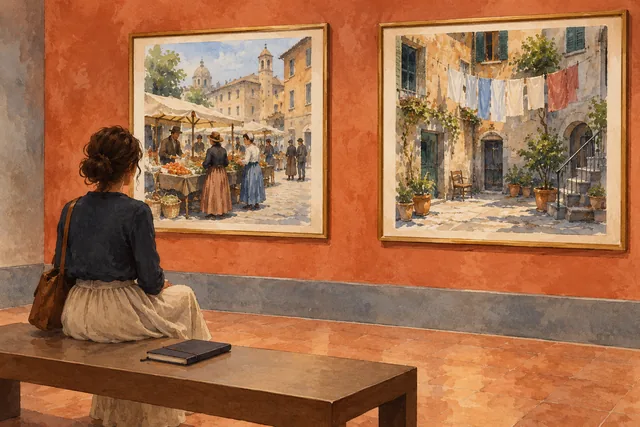
Try giving a single painting two visits. On the first pass, notice the arrangement of shapes, the direction of light and any impression of distance. On the second, read the label and ask whether the title changes your attention. If an image feels unsettling, you do not need to solve it immediately. Describe what produces that feeling before reaching for a large explanatory word.
Compare a room, not just a pair of pictures
A sculpture asks you to think about position in a different way. Without stepping beyond barriers, consider what changes as you move: the outline, the apparent balance, the relationship with the wall behind it. Then return to a picture nearby. A painted shadow and a real shadow can behave differently, and a quiet room makes that difference surprisingly enjoyable to notice.
These are independent suggestions for looking, not advertised museum workshops. They can be adapted to whichever works are actually installed. Temporary exhibitions may introduce another set of materials or ideas, so read their introduction separately. It is perfectly reasonable to give a small selection proper attention and leave another section for a future visit. More labels read does not necessarily mean more art understood.
Check the present admission rules
Do not rely on an old recommendation calling this museum universally free. On the official ticket page checked on 22 October, general admission for the museum and exhibitions is paid, with reductions and exemptions for specified visitors. Rome and metropolitan-area residency, a valid MIC card and other eligibility categories affect the rules. Check the current conditions and bring any required evidence; being in a public park does not itself establish free museum entry.
The current timetable lists Tuesday to Friday from 10:00 to 16:00 and weekends from 10:00 to 19:00, with last admission 45 minutes before closing. Monday is normally closed. Confirm special notices for your actual date. If you are arranging a group, read the group-booking requirements separately rather than assuming that an ordinary individual ticket covers an organised visit.
Make the park part of the plan
Allow a comfortable margin for finding the entrance within Villa Borghese. A museum destination on a park map is not the same as a short walk from every gate. Decide where you will begin and end, and avoid filling the gap between two fixed appointments with a hurried cross-park march. On a warm day, a drink and a pause before entering may improve your concentration more than another attraction added to the list.
Our Villa Borghese family-day guide helps with that rhythm. Nearby artistic contexts include Museo Pietro Canonica and, as a separate visit, Galleria Nazionale. Browse our Rome experiences for explicitly described itineraries, without assuming Bilotti admission is included.
For a comparison on another city trip, Bologna’s MAMbo offers a different approach to modern and contemporary art. Here, let the orangery remain part of the encounter: not background decoration, but a reason to notice how a collection inhabits a place.
Sources & further reading
Turn a good read into a great day.
Find a highly rated Rome experience that brings these stories to life.
Explore related experiences →