Rome’s Andersen Museum: how do you look at an artist’s dream of a world city?

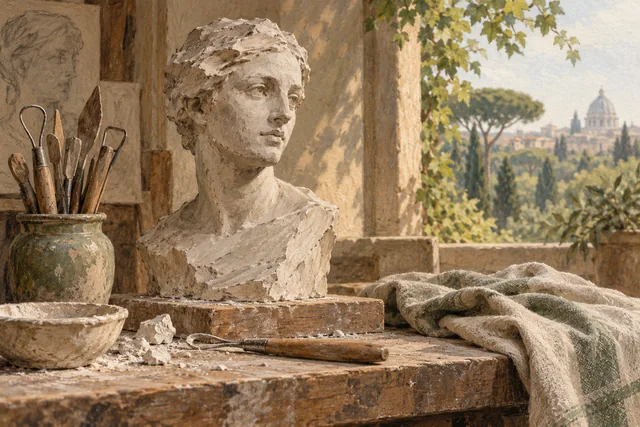
A sculptor’s studio can make an idea feel surprisingly physical. At Rome’s Casa Museo Hendrik Christian Andersen, scale is a particularly useful starting point: how does a figure relate to a room, and how might an artist imagine a room expanding into a city? You do not need to endorse the artist’s ambitions to enjoy examining how they took shape. Curiosity is a better entrance requirement than agreement.
Meet the artist behind Villa Helene
This is the home and work of the Norwegian-American sculptor Hendrik Christian Andersen, who lived from 1872 to 1940. It is not a museum of the Danish fairy-tale writer with a similar name. The official museum account describes a house built and decorated for Andersen from 1922, with the name Villa Helene honouring his mother. The building therefore belongs to the story, rather than serving only as a neutral container for sculpture.
The collection is closely connected to his proposal for a world city devoted to international intellectual and cultural exchange. Treat that as an artistic and social ambition, not a city that was constructed as planned. The difference matters: the museum lets you investigate how a proposed future was represented. Our Pietro Canonica studio guide provides a useful comparison with another sculptor’s Roman environment, while preserving the different purposes of the two collections.
Let scale do some of the explaining
Choose one object that you can comfortably see from the permitted route. First compare its height with your own, then with a doorway or the room around it. Does it feel suited to close conversation, a public square, or an imagined distant viewpoint? These are questions you can ask without assuming its intended original placement. Read the label afterwards to discover whether the documentation supports your first impression.
Try the same exercise with a smaller work. A compact object can still suggest public grandeur, while a large figure can contain a surprisingly intimate gesture. Keep those two effects separate from technical quality or personal taste. You might dislike a particular pose yet find the artist’s use of scale fascinating. A museum visit becomes richer when “I like it” is the beginning of a conversation rather than its only possible conclusion.
Read ambition with a little distance
The idea of a world city invites questions about whom an ideal place is designed for and how it imagines people living together. Use those questions as your own response to the collection; they are not a substitute for evidence about Andersen’s intentions. It is perfectly reasonable to leave with an unresolved question. Art made to express a large programme can be most engaging when you notice where your own expectations differ from it.
For a contrasting kind of international cultural encounter, our Casa di Goethe guide focuses on travel and literary memory. Both places can broaden a Rome itinerary beyond a checklist of celebrated ancient monuments. They need not be visited back-to-back: choose the subject that suits your energy, and allow enough time to absorb it before switching centuries and media.
Check the room notice before you go
As checked on 24 October 2026, the museum’s official page still carries a notice that restoration and maintenance beginning on 27 July temporarily close the ground-floor Bronze Room. Do not plan on seeing that room or assume that every work in an online collection description is currently accessible. Check the notice again shortly before visiting. The same page gives a maximum visit duration of sixty minutes and distinguishes ordinary opening from selected exceptional Monday afternoons.
That distinction is worth checking carefully because official pages currently list different exceptional Monday dates. Use the museum’s current ticket calendar and direct confirmation for a particular Monday; do not turn a general timetable into a promise. For a group with its own guide, consult the museum’s advance-booking rules rather than arriving on the assumption that several individual tickets constitute a group reservation. An ordinary independent visit and a guided group have different practical requirements.
Leave space for the surrounding city
After an intensive indoor visit, a walk can help ideas settle. Our Rome botanical garden planning guide is a separate outing, not an immediately adjacent add-on, and is useful if you are balancing collections with green space across several days. For a longer cultural itinerary, compare Rome art experiences by actual inclusions rather than assuming a small house museum is included.
If your trip continues to Florence, Florence Tour Hub’s Museo Horne guide offers a different question: how does a collector arrange the past? Andersen asks how an artist might imagine the future. Keeping those questions distinct makes both visits more rewarding, and gives you something more memorable to take away than another list of names.
Sources & further reading
Turn a good read into a great day.
Find a highly rated Rome experience that brings these stories to life.
Explore related experiences →