Is Ostia Antica worth a day trip from Rome?
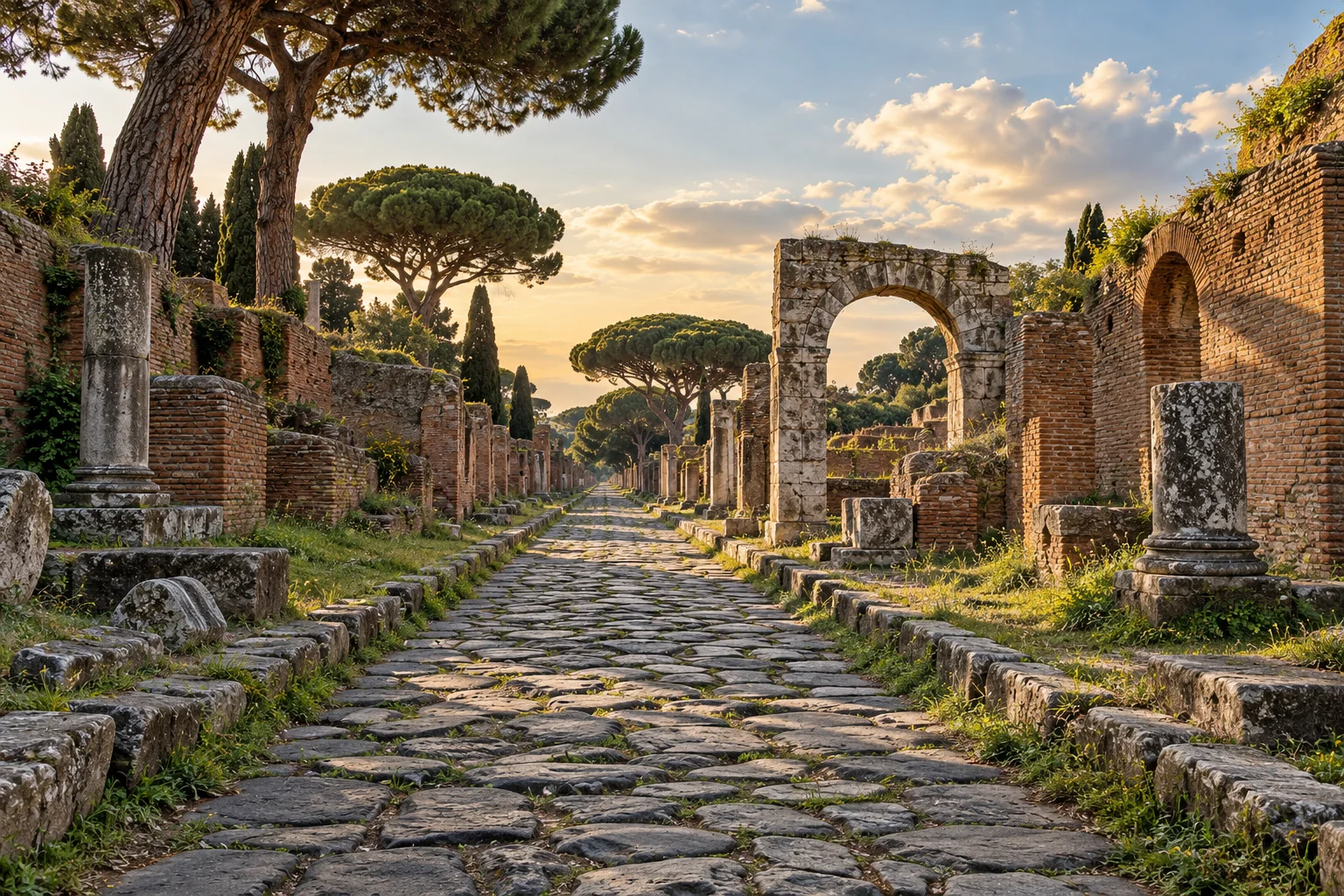
Ostia Antica is worth considering if you want to explore the spaces of an ancient town at a different scale from Rome’s most famous monuments. It suits travelers curious about streets, work, bathing and the relationships between buildings. It is less suitable as a hurried extra squeezed between a late breakfast and an immovable afternoon appointment back in the city. Give the outing enough time to become a visit rather than a transfer with ruins attached.
You do not need to declare it better than another archaeological site. Ask whether this kind of looking interests you and whether your party can comfortably manage an outdoor visit. Our day-trip collection can help compare guided options. Check whether any offered experience includes transport, the correct site admission and enough time on the ground for the route described.
Understand which part of the park you are visiting
The official archaeological-park website presents several distinct places, including the Ostia archaeological area and other sites in the wider park network. These are not all parts of one continuous walk that can be entered casually from the same gate. Confirm the exact destination named on your ticket or tour, especially when an offer uses the broad park name rather than a precise visitor entrance.
For a first trip, concentrating on the main archaeological area is a sensible choice. Study its current map before deciding that you will also reach another site. An administrative relationship between places does not establish a quick physical connection. The same principle applies to museums within a park: their opening arrangements may differ from those of the outdoor area around them.
Choose an everyday-life theme
A useful first theme is the relationship between public and private activity. Look at how streets connect places, where a large shared building occupies space and how the scale changes as you move. Let the official interpretation identify functions rather than guessing from a doorway’s shape. An ancient room is not automatically a shop merely because it opens conveniently toward a street.
The park’s account of the Forum Baths palaestra describes an open-air exercise space beside the bathing complex. That gives you a concrete relationship to look for: exercise, movement and bathing within a connected setting. You can use one well-explained example to understand the town more deeply than by collecting the names of every building without seeing how any of them worked together.
Expect an archaeological landscape, not an intact city
Surviving remains, restoration and explanatory reconstructions all contribute to what visitors see. Pay attention to the distinction between an original fragment and a proposed complete form. A wall height or missing upper floor can make a place difficult to imagine, but the uncertainty is part of the evidence. A good guide helps explain both what is known and where interpretation remains necessary.
Walk only where access is permitted, avoid climbing structures and leave fragments where they are. These are also practical ways to slow down and look accurately. The strongest moments often come from a small observation—a threshold, a surface or a change in alignment—followed by a reliable explanation. You do not need a spectacular reconstruction in every direction to find the place absorbing.
Plan for the conditions on the ground
Consult the official visitor information for the date-specific hours, last admission, closures and available services. Seasonal closing times affect how much time remains after your journey. Outdoor exposure and uneven surfaces also matter. Choose footwear, water and clothing for the actual forecast, and identify where the group can pause rather than assuming every section offers the same comfort or facilities.
If access requirements are important, contact the site about the specific route you want to follow. Do not interpret the availability of one access service as proof that every archaeological path is suitable for every visitor. A shorter planned route may be far more enjoyable than discovering limitations after the group has already traveled a long way through the site.
Give the journey its own attention
Use our Rome transport guide as a planning framework, then verify the current operator, station, ticket coverage and final walk for this particular outing. Check the return before setting out. A city contactless-payment assumption should not be extended automatically to every regional service or replacement arrangement. Guided transport may be convenient, but read the actual departure and return conditions carefully.
For a contrasting excursion, compare Tivoli’s two villas. For Rome’s central archaeological monuments, the specialist Colosseum guide remains useful. Ostia earns its place when you want time with the texture of an ancient settlement: not a substitute for every other site, but a different and worthwhile way to ask how people organized a town and lived within it.
Sources & further reading
Turn a good read into a great day.
Find a highly rated Rome experience that brings these stories to life.
Explore related experiences →