What can you read on the wooden doors of Santa Sabina in Rome?

The wooden door at Santa Sabina asks you to do something that feels slightly odd at a church entrance. Pause before crossing it. Set into the central portal of the basilica on the Aventine, the fifth-century door carries carved scenes from scripture. Their scale belongs to the person standing nearby. Just beyond them stretches a nave designed for a whole congregation. Moving between those two distances is a remarkably good introduction to early Christian art in Rome.
Find the door in the entrance porch
Coming from the Orange Garden side of the Aventine, allow a separate stop for the basilica. The object you are looking for is in the covered entrance area, often called the narthex. At the central portal, the dark cypress wood sits within an older marble surround. Stone gives the opening a firm outline that you can pick out from several paces away. As you draw closer, the separate relief panels begin to resolve. Rome’s municipal account of Santa Sabina identifies both materials and the biblical subjects.
Choose a place to one side so that a family arriving for worship can move freely through the entrance area. Sightseeing in a doorway works best in short intervals. If people are gathering, cross into the church if admission is open, or continue the Aventine garden walk and return when the space is quieter. A distant view framed by the columns can be more revealing than trying to photograph the upper carvings over somebody’s shoulder.
Choose one gesture before trying to name a scene
Carved relief creates a picture by leaving some of the surface standing proud of the rest. From one angle an arm or the edge of a garment casts a narrow shadow. Shift a little and the shadow merges with a neighboring line. Pick two figures. Can you tell which one is turning toward the other? How much of that relationship can you see in the angle of heads or the spacing between bodies, even if you cannot identify the episode?
One panel has an especially early representation of the Crucifixion. That makes the doors famous, but it is worth taking your time with the rest. When a panel has been described to you in advance, it is easy to mistake recognition for close looking. Choose a second panel that you cannot name. Describe to a companion where the figures are placed and which one first drew your eye. You will have a better sense of how a carver tells a story within a rectangle.
A recent lighting project gave the door and several features inside the basilica specific attention. The account identifies the door’s location and its fifth-century Crucifixion image. It also explains why the wood can look quite different from one photograph to another. The direction of light changes the apparent depth of a cut. Turismo Roma’s account of the lighting work.
Turn round inside the nave
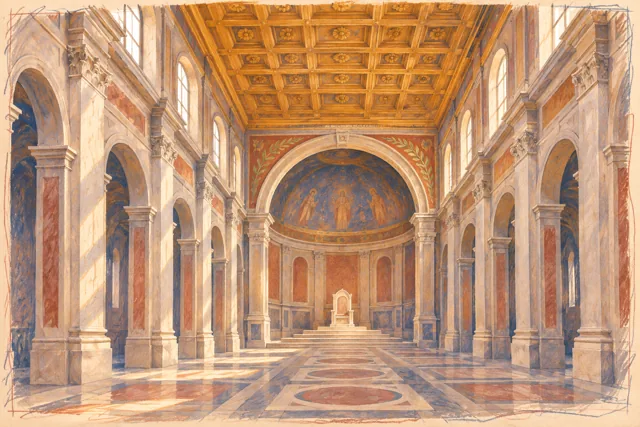
If the church is open to visitors, take in the length of the aisle, then turn toward the entrance wall. The early mosaic inscription names Peter of Illyria, associated with the founding of the church, and Pope Celestine I. Gold lettering stands out against blue. The change of medium is also a change of audience. Words set high on a wall assert a presence across a large interior. A small carving at the entrance rewards someone who can stop a few paces from it.
The present interior reflects centuries of decisions, including an early twentieth-century restoration under Antonio Muñoz. When the long ranks of columns make the space look unusually clear, remember that people helped determine which layers would be visible today. Compare Santa Prassede’s use of mosaic in a living church on a separate outing. Seen on their own terms, the two interiors offer quite different answers to the question of where a worshipper’s attention goes.
Leave as much room for worship as for looking
Service times and sightseeing access can differ. Use the basilica information linked above and follow local directions if the entrance or part of the interior is reserved for worship. Our guide to seeing art in Rome’s churches is useful when planning several stops without placing all of them on a tight timetable. If you are choosing a guided outing from the Rome art collection, check whether Santa Sabina itself appears in the route.
On the way out, look at the doors from the place where you first saw the marble surround. After the scale of the nave, the wooden scenes may seem smaller than you remember. That difference is part of their power. The building has room for a congregation, yet it can still address the next person to arrive through the turn of a single carved head.
Sources & further reading
Turn a good read into a great day.
Find a highly rated Rome experience that brings these stories to life.
Explore related experiences →