Rome’s Boncompagni Ludovisi Museum: how do useful objects become a collection?

A chair has a job to do. So does a dress, a cabinet or a vase, even when their owners also expect them to impress. Rome’s Boncompagni Ludovisi Museum makes that double life a useful subject for a visit. Instead of treating decorative objects as the supporting cast around paintings, give them the leading roles. Ask how something designed to be used acquires a second career as evidence of taste, work and social life.
Begin with the house rather than an imaginary department store
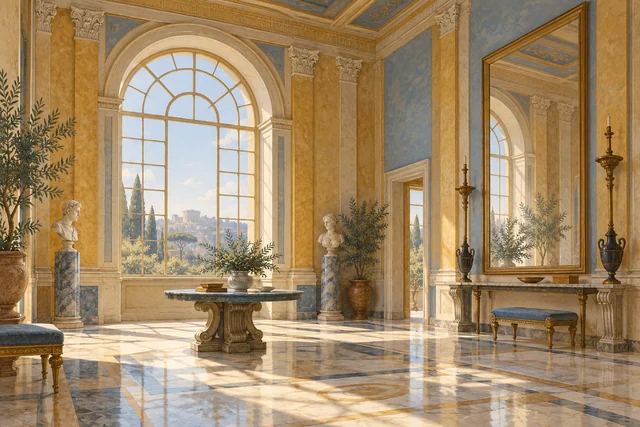
The museum occupies an early-twentieth-century villino associated with the Boncompagni Ludovisi family. Its official brochure identifies the architect as Giovanni Battista Giovenale and places the design in 1901. A house gives these collections a different setting from a neutral exhibition hall: scale, doorways and the relationship between rooms all become part of the encounter. That does not mean every object has always stood exactly where it is displayed today.
The property was donated to the state in 1972, and the museum opened in 1995. Its remit includes decorative arts, costume and fashion. Collections and temporary displays therefore bring together different sorts of evidence, from furnishings to clothing. The institution’s own history is worth remembering when you read a label: a family residence and a public museum select and arrange things for different purposes.
Follow one material through several decisions
Choose a material you can recognise without touching anything: wood, ceramic, glass or fabric. First describe what it appears to do. Does a curve support weight, provide a handle or simply catch the light? Then look for the maker, date and technique on the label. Those details can move the object from a vague impression of luxury into a more precise history of production.
Try separating the material from its pattern. A floral design can travel between media, but carving a leaf in wood is a different task from weaving one into cloth. Notice where a surface repeats and where it changes at an edge or join. You are making a visual comparison, not identifying an undocumented workshop. Leave room for the label to correct an attractive first guess.
Let clothes raise questions about bodies and occasions
Clothing is especially good at resisting the idea that a museum object exists only to be looked at. A garment had to accommodate movement, fastening and a particular occasion. From the permitted viewing distance, consider how it might have been put on and what posture its shape seems to encourage. These are questions to test against documentation, not permission to invent its wearer’s daily routine.
The museum records important donations, including clothing associated with Palma Bucarelli. A named provenance can connect dress to an individual life, while an unidentified object requires a different level of caution. Neither should be treated as a statistically typical Roman wardrobe. Surviving collections are selective: what was kept, donated and considered worth preserving influences the story available to us.
Check the current rooms before making a special journey
As checked on 26 October 2026, the museum’s official page warns that the piano nobile is not fully accessible during maintenance and improvement work. Confirm which rooms can be visited if a particular collection is your main reason for going. The regular opening pattern is Tuesday to Sunday, with Monday closure; an old special-opening announcement is not evidence of another Monday opening.
Use the current museum page for tickets and access information. Older brochures remain valuable for history but may describe admission arrangements that have changed. If steps, lifts or seating affect your visit, ask about the route actually operating that day. A partial room restriction is a practical planning fact, not a reason to pretend the collection has disappeared.
Build a small comparison rather than a crowded itinerary
Our Mario Praz Museum guide considers a collector’s arrangement of rooms; the Andersen Museum article approaches an artist’s ambitions through his work. At Casina delle Civette, glass offers another way to think about objects and designed interiors. These are alternative visits, not a promise that every institution shares the same hours or ticket.
For a guided art outing, compare Rome arts experiences by their named inclusions. Florence’s Prato Textile Museum guide extends the material question into a separate city excursion. At Boncompagni Ludovisi, one carefully observed object is enough to begin: what did it help someone do, and what does the museum now help us understand?
Sources & further reading
Turn a good read into a great day.
Find a highly rated Rome experience that brings these stories to life.
Explore related experiences →