Rome’s Santa Costanza: how do mosaics change as you walk around the building?

At Santa Costanza, looking up and moving around belong to the same activity. The curved passage around the central space changes your view as you walk, and its mosaics reward attention to both images and rhythm. This is a place to take slowly: a circuit, a pause, and then another look at something that appeared quite different from a few steps away.
The mausoleum forms part of the Sant'Agnese fuori le mura complex on Via Nomentana. Plan it as a separate outing from the central archaeological area, with its own journey and opening arrangements. The complex's current visitor information lists Santa Costanza daily from 9am to noon and 3pm to 6pm. Visits are suspended during liturgical celebrations. Those intervals describe the mausoleum, not an automatic combined visit to every part of the complex.
Read the circle before reading the pictures
The city's Turismo Roma description identifies the building as an important example of late-antique architecture with a central plan and an ambulatory, the surrounding passage. Begin by noticing that arrangement. Where does the space feel enclosed, and where can you see across it? The columns help organise both movement and sight.
You do not need to walk continuously while looking upward. Stop somewhere that leaves a clear route for others, examine one area, then move to a new position. A photograph can flatten the building into a decorative ceiling. Looking between the passage and the central space restores the relationship between surface and architecture.
Look for repeated motifs and changes of pace
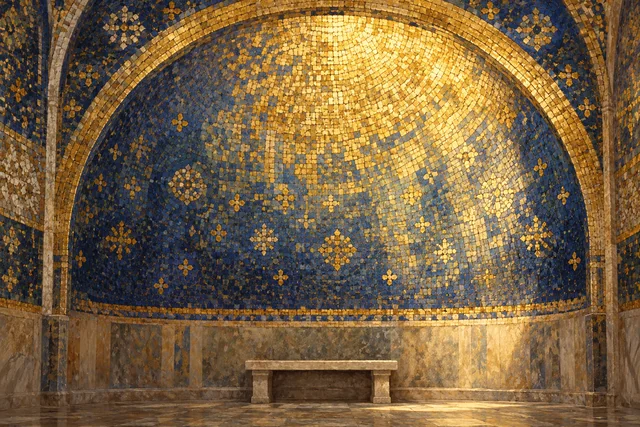
Turismo Roma describes fourth-century mosaics in the passage vault, including geometric patterns, fruit, flowers, birds and vintage scenes. Rather than trying to identify every figure immediately, choose a repeated form. Follow a vine or notice how an area of pattern differs from a scene involving action. Repetition can make the small differences easier to see.
The same official account explains that the imagery contributed to the building's later identification as a temple of Bacchus. That mistaken label is a useful warning: a familiar motif does not establish a building's original function by itself. Images can be reused and reinterpreted in different settings. Ask how decoration, architecture and the site's history work together before making a confident conclusion.
For another Roman encounter with mosaic imagery in an active religious setting, our Santa Prassede guide provides a helpful comparison. The point is not to arrange two monuments into a simple ladder of progress. Their different spaces, dates and uses give you different questions to ask.
Keep the parts of the complex distinct
Santa Costanza, Sant'Agnese's basilica and the catacombs have separate access arrangements. A mausoleum opening is not a catacomb tour booking. The operator's current notices include a catacomb closure from 16 November to 6 December 2026; that notice should not be silently extended to the mausoleum, nor ignored if you are planning an underground visit. Recheck the operator's own page for your actual date.
This distinction is particularly useful when travelling with mixed interests. Someone may want a focused architectural visit, while someone else wants a guided explanation of burial spaces. Agree on the shared part of the outing first, and confirm any additional admission separately. Our Rome transport guide can help with the wider journey, but current route information should determine the final connection.
Give the building room to remain a church
The visitor timetable explicitly yields to worship. Keep voices low, respect any area reserved for a celebration and avoid treating a pause in access as a problem that a different ticket should solve. A quiet interior may also contain people who are there for reasons unrelated to sightseeing. Observe their space without turning them into the subject of a photograph.
Choose one observation to discuss afterwards: perhaps how a curve changed the view, or how a repeated leaf became a scene of harvest. Our guide to art in Rome's churches encourages this kind of concentrated looking. The Rome art collection can help you choose another outing without assuming all churches share the same arrangements.
Connect late antiquity to a wider Rome visit
Santa Costanza also offers a useful bridge between a museum's objects and a city's surviving spaces. If you are combining it with archaeological visits, the specialist Colosseum Tour Hub guide to San Clemente explores a different kind of historical layering. Keep the journeys separate unless you have generous time. Two thoughtfully examined buildings usually leave a clearer memory than a hurried attempt to make every century fit one afternoon.
Sources & further reading
Turn a good read into a great day.
Find a highly rated Rome experience that brings these stories to life.
Explore related experiences →